A Composite Skill Lab (CSL) helps students understand different forms of practical work through hands-on experiences, projects, and real-world applications. The NCF-SE 2023 framework organises skill education around three broad Forms of Work: Work with Life Forms, Work with Machines & Materials, and Work in Human Services.
While the first two tracks focus on working with living systems or physical technologies, Work in Human Services focuses on people, their needs, choices, services, communication and decision-making.
In STEMpedia’s CSL model, this track is introduced through Finance & Entrepreneurship, helping students practise money management, budgeting, banking, business thinking and service-related communication.
Make Smart Choices. Create Value.
The goal is not to turn students into accountants or business owners immediately. The goal is to build practical confidence with money, decisions, and communication — skills that apply across every career path.
For a broader understanding of the CSL structure, schools can first read What Is a Composite Skill Lab? A Complete Beginner’s Guide for CBSE Schools.
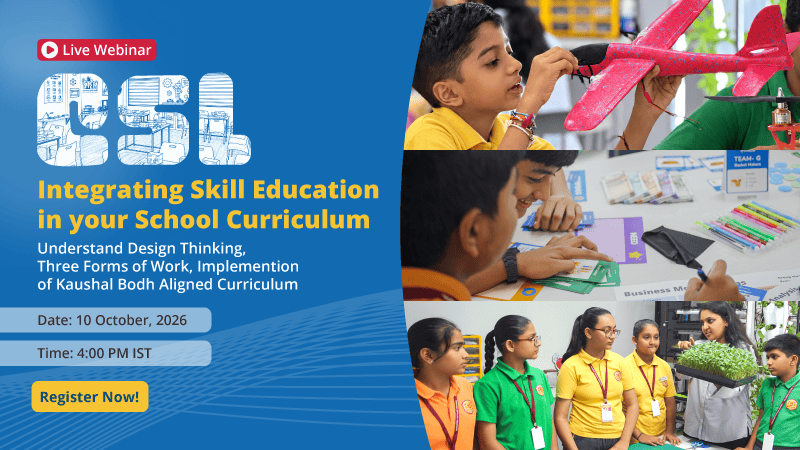
Click here to register and join our live session to understand the setup, curriculum, activities, and implementation approach for CBSE schools.
What Is Work in Human Services?
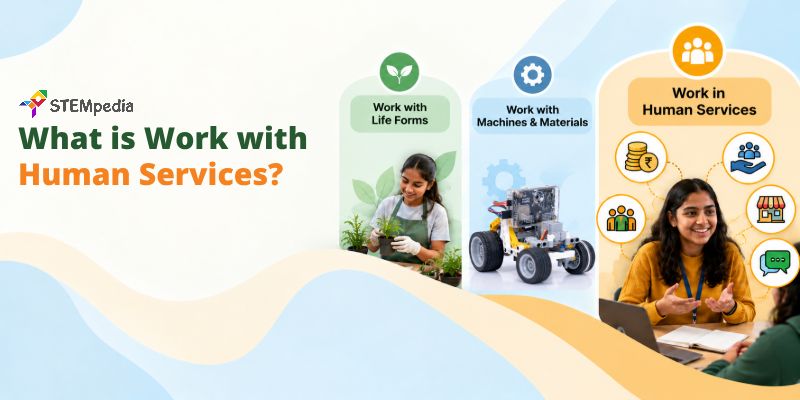
Work in Human Services covers practical activities centred on understanding people’s needs and providing services to meet them. It includes service-oriented areas such as healthcare, retail, tourism, hospitality, banking, financial services, and insurance.
Within STEMpedia’s CSL model, this Form of Work is introduced through a focused, age-appropriate pathway: Finance & Entrepreneurship.
Students explore:
- Financial literacy
- Money management
- Banking
- Budgeting
- Entrepreneurship
- Business fundamentals
- Consumer services
- Communication
Students learn by making decisions, handling simulated money, planning small ventures, understanding customer needs, and practising communication.
The learning arc is simple:
Understand Needs → Make Decisions → Manage Resources → Create Value
Finance & Entrepreneurship — STEMpedia’s Human Services Track
The Human Services track becomes practical when students learn through everyday financial and service-based decisions.
- Financial Literacy: Students learn the basics of money: income, expenses, saving, needs and wants. This builds a foundation for responsible financial behaviour.
- Money Management: Students practise tracking spending, setting savings goals and making trade-offs using classroom activities and simulated situations.
- Banking: Students explore basic banking concepts such as accounts, deposits, interest and simple banking services. This helps them understand a system they will use in real life.
- Budgeting: Students learn how to plan costs, manage limited resources, and make decisions within constraints.
- Entrepreneurship: Students identify a need, develop a simple product or service idea, estimate resources, and plan how to present it.
- Business Fundamentals: Students explore pricing, profit, customers, competition, and value through relatable classroom scenarios.
- Consumer Services: Students understand what makes a service helpful, reliable, and customer-friendly.
- Communication: Students practise explaining an idea, pitching a product, handling customer interactions, and presenting decisions clearly.
These areas convert finance and entrepreneurship from abstract terms into practical classroom experiences.
Connecting Finance with Real-World Decision-Making
This track becomes meaningful when students apply financial thinking to decisions they can understand and practise.
Examples include:
- Budgeting + Entrepreneurship → Planning a Small Student Venture
- Consumer Services + Communication → Handling a Customer Interaction
- Banking + Financial Literacy → Making an Informed Saving Decision
- Pricing + Business Fundamentals → Understanding Profit and Cost
- Needs + Services → Designing a Useful Product or Service
The focus is not memorising financial terms. The focus is helping students make better decisions involving money, value, people, and services.
The Student Learning Journey
Students progress through a simple practical pathway:
- Explore: Students understand money, value, needs, wants, services and basic business ideas.
- Experiment: Students practise budgeting, saving, simple banking tasks and mock buying-selling situations.
- Build Solutions: Students plan a small venture, service idea, budget model or customer-service simulation.
- Present Outcomes: Students showcase their plan, pitch, role-play or simulation through demonstrations and exhibitions.
This follows the broader CSL learning approach:
Learn → Explore → Build → Apply → Create → Present
Why This Track Belongs in a Composite Skill Lab
A Composite Skill Lab should not focus only on machines, coding, or tools. Students also need to understand people, communication, money, and decision-making.
Including Work in Human Services helps students build:
- Financial confidence — comfort with money-related decisions.
- Entrepreneurial thinking — the ability to identify a need and shape a basic plan.
- Communication skills — explaining, pitching, and interacting clearly.
- Service mindset — understanding customer needs and responsible service.
- Real-world readiness — practical decision-making that applies across careers.
This track brings the people-focused side of skill education into the CSL. It balances the technical and agricultural tracks by helping students understand how value is created, communicated, and delivered to others.
Schools deciding how to balance the three Forms of Work can also refer to How Should a School Choose Its Three CSL Domains?.
Tools STEMpedia Uses for the Human Services Track
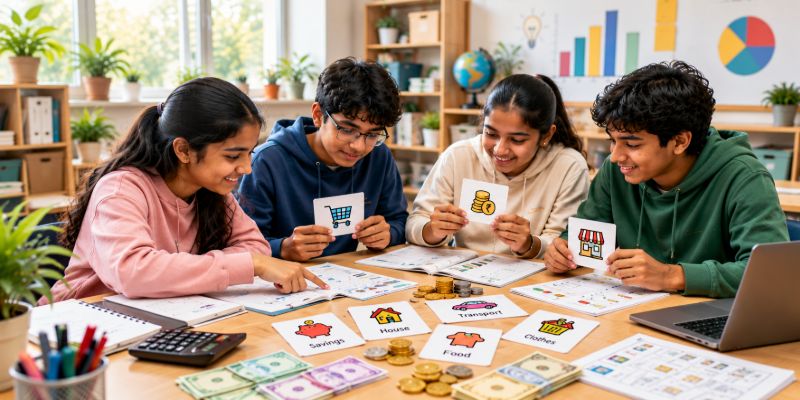
Unlike the Machines and Materials track, this track does not require heavy equipment. It is deliberately low-tech, scenario-driven, and decision-based.
STEMpedia uses tools such as:
- Flash Cards — to reinforce financial and business concepts.
- Scenario Cards — to help students solve real-world money and service situations.
- Play Money Kits — to practise budgeting, transactions, savings and banking safely.
These resources help students learn by doing: planning, comparing, discussing, role-playing and making decisions.
The Human Services track carries 20 of the 100 annual sessions in STEMpedia’s CSL curriculum and builds toward a student project presented at the Kaushal Mela.
For schools reviewing infrastructure and resources, Composite Skill Lab Tools and Equipment for CBSE Schools can be used as a supporting reference.
Sample Finance & Entrepreneurship Projects

Students can apply this track through simple, practical projects such as:
- A mock business plan and pitch for a small product or service
- A personal budgeting activity using Play Money Kits
- A classroom bank simulation with deposits, savings and interest
- A consumer-service role-play showing good and poor service experiences
- A student enterprise simulation involving pricing, cost and basic marketing
- A needs-vs-wants decision activity
- A savings-goal planning challenge
- A simple customer-feedback and improvement activity
Each project asks students to combine financial reasoning with communication. This turns concepts like budgeting, banking, and entrepreneurship into decisions students can actually practise.
How STEMpedia Supports This Track
A successful Human Services track requires more than a few worksheets. Schools need a structured plan that connects activities, teacher support, learning resources, and student outcomes.
STEMpedia’s wider CSL ecosystem supports this through:
- Structured curriculum
- Activity-based learning resources
- Flash cards and scenario-based tools
- Teacher training
- Practical implementation guidance
- Student project and showcase opportunities
The Human Services track works alongside Work with Life Forms and Work with Machines & Materials to complete the three Forms of Work inside a connected Composite Skill Lab model.
Schools planning the larger CSL implementation can also refer to:
- Teacher Training for Composite Skill Labs – How Schools Can Build CSL Readiness?
- How to Set Up a Composite Skill Lab in Phases – From Readiness to Launch
- Composite Skill Lab by STEMpedia: A Complete NEP 2020 & NCF-SE Aligned Solution
Conclusion
Work in Human Services gives students practical exposure to money, decisions, communication, service, and entrepreneurship.
Through Finance & Entrepreneurship, students move beyond knowing financial terms. They practise making choices, managing resources, understanding customers, and presenting ideas.
The learning arc is:
Understand Needs → Make Decisions → Manage Resources → Create Value
This completes STEMpedia’s Composite Skill Lab model alongside Agriculture under Work with Life Forms and AI, Robotics & ICT under Work with Machines and Materials. Together, these three tracks create a balanced CSL ecosystem where students grow, build, serve, decide, and present.
Schools can explore STEMpedia’s complete Composite Skill Lab solution: