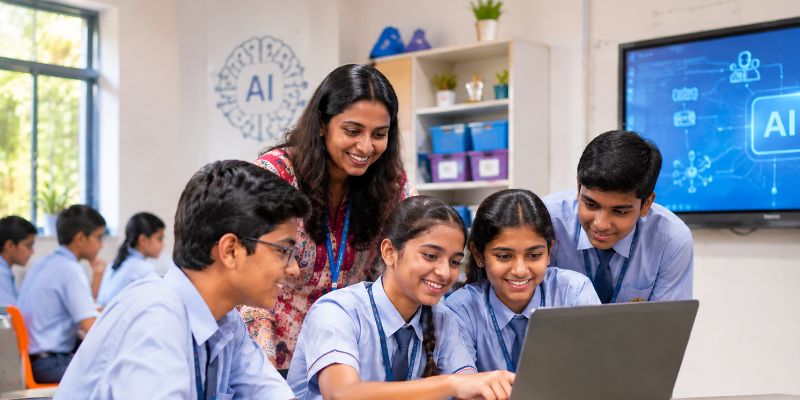
CBSE’s new AI education updates are here! Is your school ready to turn future-ready skills into real-world learning?
The Central Board of Secondary Education (CBSE) released Circular Acad-70/2026 on 29 October 2026, clarifying the Scheme of Studies for Class IX students in 2026–27 who will progress to Class X in 2027–28.
One important takeaway for schools is that Artificial Intelligence (AI), Subject Code 417, remains one of the available skill subjects. However, the separate Computational Thinking and AI (CT & AI) modules are not included in the curriculum for this Class IX batch.
What does this mean for AI education, subject selection, and classroom preparation? Let’s explore.
What Does the New CBSE Circular Say About Artificial Intelligence?
The latest CBSE circular reinforces the importance of skill-based education, making Vocational Education a compulsory curricular area for Class IX students in the 2026–27 academic session.
Students can choose between Kaushal Vikas and one of 22 recognised skill subjects, including Artificial Intelligence (417), Information Technology (402), Data Science (419), and Design Thinking and Innovation (422).
The distinction is important:
| CBSE Curriculum Area | What Applies to Class IX (2026–27)? |
| Vocational Education | Compulsory curricular area for all students |
| Artificial Intelligence (417) | Available as one of the 22 skill-subject choices |
| Kaushal Vikas | Alternative pathway with school-based internal assessment |
| Computational Thinking & AI | Separate CT & AI modules are not part of the curriculum for this batch; AI 417 remains available |
| Class X (2027–28) | Students choosing AI 417 must appear in the respective Board Examination |
For complete details, refer to the Official CBSE Circular Acad-70/2026.
Why Artificial Intelligence Education Matters
AI is becoming part of everyday life, from recommendation systems and voice assistants to image recognition and intelligent automation.
For students, learning AI is not only about understanding technology. It is also about developing skills that help them analyse problems, recognise patterns, question information, and make informed decisions.
CBSE’s Artificial Intelligence (417) curriculum for Class IX, 2026–27, introduces areas such as the AI project cycle, data literacy, AI ethics, generative AI, and basic Python programming.
These are practical skills that become more meaningful when students can experiment, create projects, and apply what they learn.
Building Artificial Intelligence Skills Before Class IX
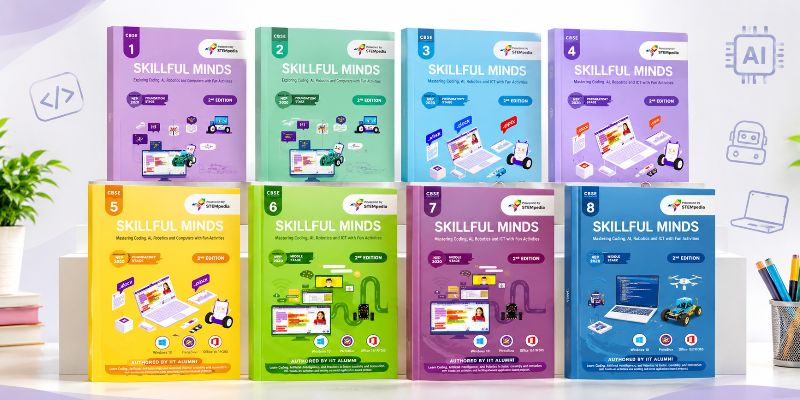
Building a strong foundation in coding, computational thinking, and digital skills prepares students for advanced AI learning. CBSE’s Circular Acad-18/2026 supports the introduction of Computational Thinking and AI in Classes III–VIII through activity-based learning.
To support this journey, STEMpedia offers CBSE-aligned Skillful Minds Computer Books for Classes 1–8, combining ICT, coding, AI, and robotics through engaging activities and practical projects.
As students progress, STEMpedia’s Artificial Intelligence Skill Subject 417 Books for Classes IX–X help them explore AI fundamentals, Python programming, machine learning, and real-world applications through structured, hands-on learning.
From first steps in coding to advanced AI projects, STEMpedia makes future-ready learning accessible, engaging, and practical.
Take the Next Step with STEMpedia’s AI Books for Classes IX and X
For schools offering CBSE Artificial Intelligence – Skill Subject 417, STEMpedia provides dedicated AI textbooks for Classes IX and X.
These books combine theoretical concepts with practical exercises and project-based learning, helping students develop a stronger understanding of AI through application.
Students can explore:
- AI Fundamentals: Understand AI concepts, applications, and their role in everyday life.
- AI Project Cycle: Learn to identify problems, work with data, develop models, and evaluate results.
- Python Programming: Develop programming skills through structured exercises.
- Machine Learning & Computer Vision: Explore practical applications of intelligent systems.
- Hands-on Projects: Apply classroom knowledge through activities, experimentation, and problem-solving.
With tools such as PictoBlox, students can move from understanding how AI works to developing their own technology-based projects.
Explore Our Learning Resources:
Conclusion
The future of education is not just about learning technology. It is about learning to think, create, and solve problems with it.
CBSE Circular Acad-70/2026 gives schools important clarity about the Class IX scheme of studies, while Artificial Intelligence (417) remains an available route for students who wish to pursue AI as a skill subject.
STEMpedia supports this learning journey with Skillful Minds Computer Books for Classes 1–8 and AI Skill Subject 417 Books for Classes IX–X, connecting foundational learning with hands-on AI education.
Allow your students to explore AI, develop new skills, and build with confidence.