
The CBSE Composite Skill Lab (CSL) helps schools create a dedicated environment where students learn through practical activities, projects, and real-world applications.
Unlike traditional laboratories that focus on a single subject area, a Composite Skill Lab brings together multiple forms of skill learning, including technology, engineering, agriculture, healthcare, design, and other vocational areas.
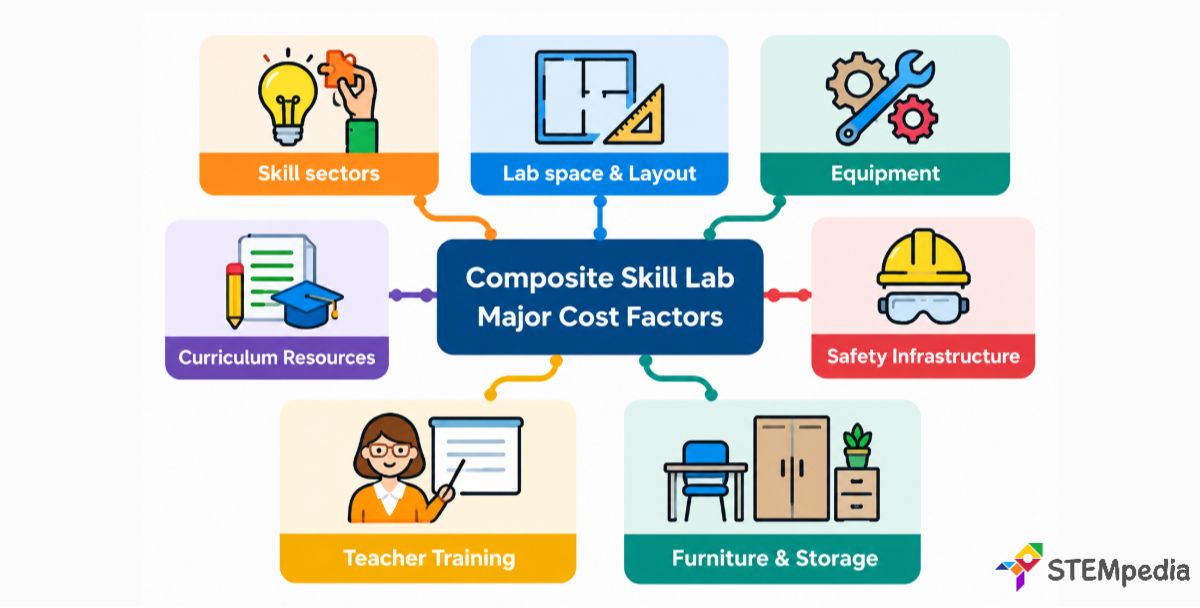
While CBSE defines the infrastructure requirements, space requirements, and skill-sector approach for Composite Skill Labs, it does not prescribe a fixed setup budget. The actual investment depends on factors such as:
- Lab size and layout
- Number of skill sectors included
- Equipment selection
- Technology integration
- Furniture and safety infrastructure
- Curriculum support
- Teacher training and implementation assistance
In practice, a CBSE Composite Skill Lab setup can range from ₹3–6 lakh for a basic implementation to ₹20 lakh or more for advanced multi-sector and technology-rich environments.
The right investment depends not only on creating a laboratory space but also on building a complete learning ecosystem where students can continuously explore, create, and innovate.
What Is a CBSE Composite Skill Lab?

A Composite Skill Lab is a practical learning space that exposes students to different forms of work and helps them develop real-world skills.
The purpose of CSL is not only to provide equipment but to create an environment where students can:
- Work with tools and materials
- Build and test projects
- Explore technology
- Solve practical problems
- Collaborate with others
- Understand different career possibilities
- Develop transferable skills
The CSL model aligns with the vision of NEP 2020 and NCF-SE 2023, which promote experiential learning, vocational exposure, and skill development from school years.
The lab enables students to move from: Learn→ Make→ Test → Improve→ Apply
CBSE Composite Skill Lab Cost in India: Complete Budget Breakdown
For initial budget planning, schools may consider the following broad indicative ranges:
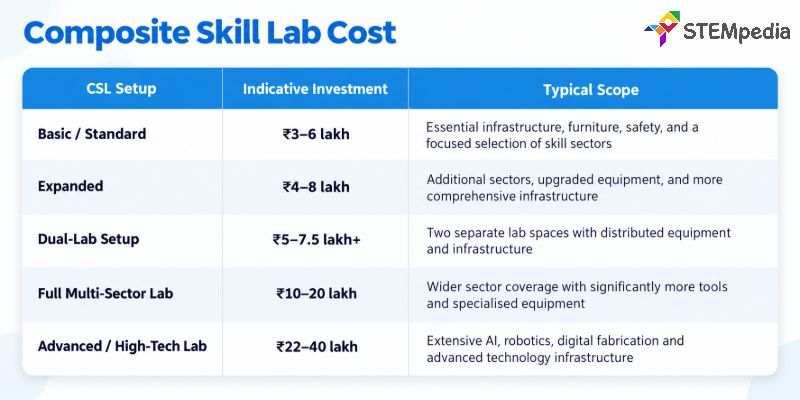
These figures should be treated as indicative planning ranges, not fixed CBSE prices. Actual quotations can vary substantially depending on the school’s requirements, location, existing infrastructure, equipment specifications, installation, training, and support.
The important takeaway is that schools should not ask only:
“What is the price of a CSL?”
They should ask:
“What level of CSL do we actually need, and what learning outcomes should that investment support?”
The cost of a CSL depends on the scale and depth of implementation.
1. Basic / Standard CSL Setup: ₹3–6 Lakh
A basic CSL is generally focused on establishing the essential infrastructure and providing students with access to a practical selection of skill areas.
A planning budget in the range of ₹3–6 lakh can be considered for a setup involving:
- Basic laboratory furniture
- Essential tools and equipment
- Storage
- Safety provisions
- Selected technology resources
- A focused combination of skill sectors
- Initial implementation requirements
The exact configuration will depend on the school’s existing infrastructure and selected sectors.
This approach can be particularly useful for schools that already have resources such as an IT Lab, ATL, makerspace, garden or other facilities that can support selected activities. CBSE allows suitable existing facilities to support relevant skill activities, although these spaces do not automatically become a complete Composite Skill Lab.
2. Expanded CSL Setup: ₹4–8 Lakh
Schools may require more investment when they want to support more skill areas or introduce more advanced equipment.
An expanded setup may include:
- More workstations
- Additional sector-specific equipment
- Better storage
- Modular furniture
- Expanded electronics and robotics resources
- Additional computers
- Digital learning tools
- More comprehensive safety infrastructure
- Specialised equipment for selected sectors
For technology-oriented learning, schools may also introduce AI, coding, robotics, IoT or computer-vision activities where these are relevant to their curriculum and implementation plan.
The key is not to purchase technology simply because it is advanced. Equipment should be connected to actual student projects and learning objectives.
3. Multi-Sector Composite Skill Lab: ₹10–20 Lakh
Some schools may plan their CSL through two separate spaces rather than one larger room.
A school may use:
- One 600 sq. ft. lab for Classes VI–XII, or
- Two 400 sq. ft. labs, one for Classes VI–X and another for Classes XI–XII.
A dual-lab model can increase expenditure because furniture, tools, storage, and other resources may need to be distributed across both rooms.
However, the cost does not necessarily have to be exactly double. Schools can determine which equipment needs to be duplicated and which resources can be shared.
4. Advanced AI and Innovation Hub: ₹20 Lakh+
A school planning a broad, multi-sector environment will naturally require a larger investment.
Different sectors can require very different equipment.
1. Life Forms
- Gardening tools
- Growing materials
- Irrigation systems
- Environmental measurement tools
- Food-production equipment
2. Machines and Materials
- Electronics components
- Microcontrollers
- Sensors
- Robotics kits
- Computers
- Coding tools
- Fabrication equipment
- Carpentry or automotive tools
3. Human Services
- Healthcare demonstration equipment
- Retail and billing systems
- Beauty and wellness equipment
- Communication and service-learning resources
The equipment requirements across these areas can vary considerably. STEMpedia’s sector-wise equipment guide similarly recommends planning tools around the school’s selected sectors rather than purchasing one universal list.
A broad multi-sector setup can therefore move into the ₹10–20 lakh range or higher, depending on the extent and specification of equipment.
5. Advanced or High-Tech CSL: ₹22–40 Lakh
At the upper end, schools may develop a technology-intensive learning environment that goes beyond the essential CSL infrastructure.
Such a setup may include:
- Advanced robotics
- AI workstations
- AR/VR
- High-specification computers
- Advanced 3D printers
- Digital fabrication
- Advanced electronics
- Robotics and automation systems
- Specialised maker equipment
At this point, the lab may begin to resemble an innovation or technology hub in addition to functioning as a Composite Skill Lab.
However, schools should be careful not to assume that a more expensive lab automatically provides better learning.
A ₹30 lakh lab that is rarely used can deliver less educational value than a thoughtfully planned ₹6–10 lakh lab that teachers use throughout the academic year.
Key Factors That Affect Composite Skill Lab Setup Cost
The price difference between CSL implementations comes from several interconnected decisions.
1. Lab Space and Infrastructure
The physical space is often the first consideration.
Schools may need to evaluate:
- Available floor area
- Electrical points
- Lighting
- Ventilation
- Water and drainage where required
- Storage
- Accessibility
- Student movement
- Workstation arrangement
- Safety provisions
CBSE’s implementation framework emphasises infrastructure readiness, lab design, tools and furniture, safety, and adaptability.
A school with a suitable existing room may have a significantly different starting cost from one that needs substantial renovation.
2. Number of Skill Sectors
The number of sectors directly affects equipment requirements.
A school selecting a focused set of sectors may require fewer specialised tools.
A school that supports many sectors will need a much broader equipment inventory.
CBSE’s framework recommends selecting skill subjects across the three Forms of Work based on factors such as local context, student interests, available resources, and teacher capacity.
This makes sector selection an important budget-planning decision, not just an academic decision.
3. Equipment Specifications
Equipment can exist at very different price points.
For example, an electronics workstation might use:
- Basic components and breadboards
- Microcontrollers and sensors
- Advanced robotics systems
- Computer-vision systems
- Automated mechanisms
Similarly, a computer workstation may be sufficient for basic coding but require higher specifications for certain AI, computer-vision or multimedia activities.
CBSE’s AI guidance includes suggested computer configurations, but these are described as suggestive specifications, rather than a universal fixed equipment package.
This distinction is important when preparing a procurement plan.
4. Furniture and Storage
Furniture is sometimes treated as a secondary cost, but it directly affects how effectively a CSL can be used.
A practical lab may need:
- Worktables
- Stools or chairs
- Storage cabinets
- Tool storage
- Pegboards
- Display areas
- Teacher workstation
- Presentation area
- Flexible collaborative workspaces
CBSE’s implementation guidance emphasises flexible workstations and reconfigurable spaces rather than treating the CSL as a conventional classroom.
A well-designed layout can also allow the same space to support multiple projects.
5. Safety Infrastructure
Safety should be considered from the beginning rather than added after equipment has been purchased.
Depending on the sectors selected, schools may need:
- Fire extinguishers
- First-aid provisions
- PPE
- Safe electrical fittings
- Tool storage
- Equipment labels
- Safety instructions
- Emergency procedures
- Appropriate supervision
CBSE’s guidance emphasises safety protocols, supervision, inspections and dedicated safety provisions within the lab.
Safety therefore forms part of the core CSL investment, not an optional add-on.
6. Teacher Training
One of the most overlooked CSL costs is also one of the most important.
A school can purchase robotics kits, computers, sensors, AI platforms and tools, but the equipment only creates educational value when teachers are confident enough to use it.
Two schools can have almost identical infrastructure and achieve very different outcomes because of differences in teacher readiness. Teachers who are prepared to conduct practical sessions, troubleshoot problems, guide teams, and assess projects are more likely to keep the lab active throughout the year.
Teacher preparation should cover more than equipment operation. It can include:
- Project-based learning
- Coding
- AI
- Robotics
- Electronics
- IoT
- Safety
- Practical assessment
- Classroom management
- Interdisciplinary projects
For schools planning AI and robotics activities, platforms such as PictoBlox and Quarky can support progression from coding and physical computing to AI and robotics.
Explore STEMpedia’s Teacher Training Programme
7. Curriculum and Learning Resources
A CSL should not be treated as an equipment room.
Schools also need to consider:
- Grade-wise projects
- Activity plans
- Learning resources
- Teacher guides
- Assessment methods
- Project documentation
- Student portfolios
- Exhibition opportunities
The implementation roadmap developed for CSLs emphasises that the process should move from readiness and sector selection to infrastructure, equipment, teacher preparation and regular timetable use.
This is why the total cost of implementation can be higher than the cost of the equipment alone.
Can Existing School Infrastructure Reduce Composite Skill Lab Costs?
Yes, potentially.
Before purchasing new equipment, schools should conduct an infrastructure audit.
Existing resources may include:
| Existing Facility | Potential CSL Contribution |
| IT Lab | Coding, AI, digital skills, finance, animation |
| Atal Tinkering Lab | Electronics, robotics, IoT, prototyping |
| Makerspace | Fabrication, design, prototyping, 3D printing |
| School Garden | Agriculture, gardening, biodiversity |
| Home Science Lab | Food-production activities |
| Existing Sector Lab | Selected healthcare, retail, automotive or other activities |
Such facilities can reduce duplication, improve resource utilisation and help schools build the CSL more efficiently.
However, there is an important distinction:
Reusing an existing facility is not the same as simply renaming it a Composite Skill Lab.
An IT Lab, ATL, or other facility does not automatically become a complete CSL. Schools still need to evaluate space, safety, storage, selected sectors, tools, and multi-sector learning requirements.
For a detailed approach, see: How Schools Can Use ATL, IT Labs, and Makerspaces for CBSE Composite Skill Lab Setup
How Can Schools Optimise Their CSL Investment?
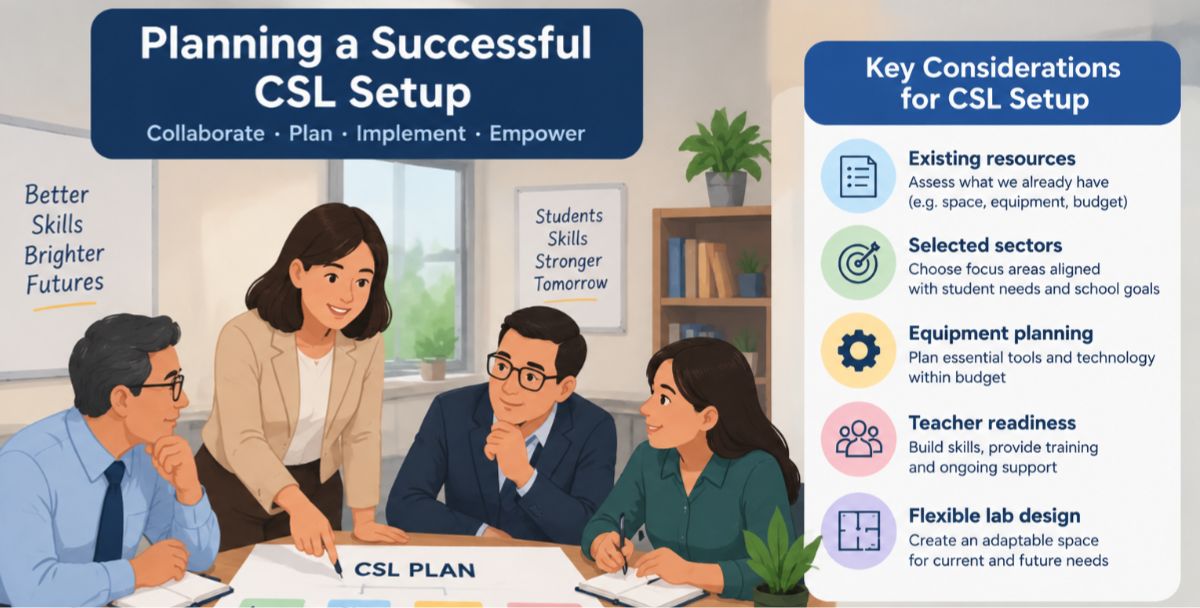
A successful Composite Skill Lab is not just about buying equipment; it requires careful planning and efficient use of available resources. Schools can optimise their investment by assessing existing infrastructure, selecting relevant skill areas, choosing reusable resources, designing flexible spaces, and evaluating complete implementation support.
1. Audit Before Buying
Begin by identifying what the school already has.
Review:
- Existing labs
- Furniture
- Computers
- Tools
- Storage
- Safety resources
- AI and robotics equipment
- Teacher capabilities
This helps prevent unnecessary duplication.
2. Select Sectors Based on Real Capacity
Do not select sectors only because they appear attractive on paper.
Consider:
- Student interests
- Local relevance
- Teacher expertise
- Available infrastructure
- Available space
- Equipment requirements
- Long-term timetable capacity
The goal should be to select sectors that the school can actually implement regularly.
3. Prioritise Reusable Equipment
Where possible, select resources that can support:
- Multiple grades
- Multiple projects
- Multiple skill areas
- Progressive learning levels
For example, a programmable board and sensor kit can support many projects instead of serving only one activity.
4. Design the Lab for Flexibility
A flexible layout can allow the same space to support different activities.
Instead of creating fixed areas that can only perform one function, schools can use:
- Modular tables
- Mobile workstations
- Shared storage
- Tool organisation
- Technology zones
- Collaborative project areas
This is consistent with the broader CSL implementation approach of creating an environment that can evolve as student needs and projects change.
5. Compare Complete Quotes
When evaluating vendors, do not compare only the equipment price.
Ask:
- Is installation included?
- Is teacher training included?
- Are curriculum resources included?
- What warranty is provided?
- What happens after installation?
- Are consumables included?
- Is technical support available?
- Can the equipment be used across multiple grades and projects?
This gives school management a much clearer picture of the true implementation cost.
How Can STEMpedia Help Schools Build a Composite Skill Lab?
Setting up a CSL is ultimately about connecting several decisions:
Infrastructure + Equipment + Curriculum + Teachers + Technology + Projects + Support
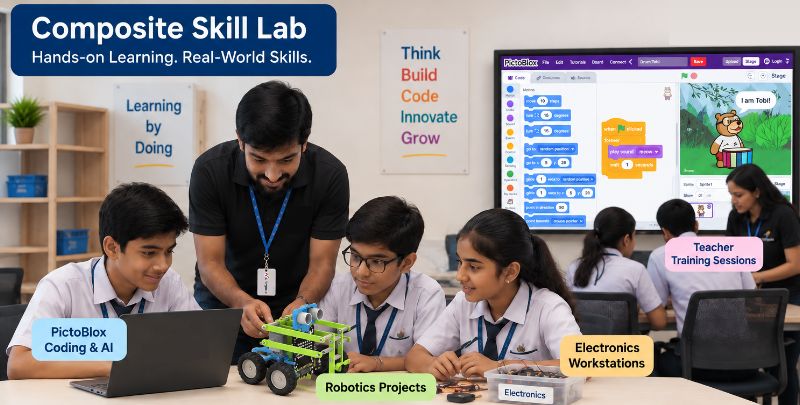
This is where an implementation partner can provide value beyond supplying equipment.
STEMpedia’s CSL approach can support schools across multiple stages.
Infrastructure Planning
Schools can receive support with:
- Lab readiness assessment
- Space utilisation
- Layout planning
- Workstations
- Storage
- Safety considerations
- Technology zones
Equipment Selection
Equipment can be planned around:
- Selected skill sectors
- Student age groups
- Curriculum needs
- Reusability
- Existing school resources
- Long-term implementation
Curriculum and Projects
A CSL becomes more meaningful when students have structured opportunities to:
Explore → Build → Test → Troubleshoot → Improve → Present
STEMpedia’s broader CSL approach positions practical learning around this kind of active project cycle rather than equipment demonstration alone.
AI, Coding and Robotics
Technology can be integrated into the wider CSL ecosystem through platforms such as:
- PictoBlox for coding, AI, Machine Learning and physical computing.
- Quarky for sensors, robotics, movement and hands-on projects.
- Quarky Intellio for computer vision, audio interaction, AI, AR and intelligent robotics.
These technology platforms should complement—not replace—the broader multi-sector requirements of a Composite Skill Lab.
Teacher Training
STEMpedia can also support teacher onboarding and practical upskilling in coding, AI, robotics and project-based learning, helping schools prepare teachers before the lab becomes fully operational.
Ongoing Implementation
The long-term objective is to help schools move from:
Lab Setup → Regular Classes → Student Projects → Assessment → Exhibitions → Continuous Improvement
This is important because the successful implementation of a CSL does not end when the equipment arrives.
Explore STEMpedia’s KFTL Composite Skill Lab approach
Conclusion
There is no single answer to “How much does a CBSE Composite Skill Lab cost?”
For initial planning, schools may consider a ₹3–6 lakh range for a basic setup, while expanded, multi-sector and technology-intensive implementations can move to ₹10–20 lakh or substantially higher, depending on scope.
But the most important budgeting decision is not choosing the largest possible equipment package.
It is choosing the right combination of infrastructure, skill sectors, equipment, technology, teacher training, curriculum and ongoing support for the school’s actual needs.
A school can begin by auditing its existing IT Labs, ATLs, makerspaces, gardens and other resources; selecting relevant skill sectors; designing a flexible space; procuring purposefully; preparing teachers; and then integrating practical projects into the regular timetable. This phased approach is consistent with the broader CSL implementation framework.
Ultimately, the strongest Composite Skill Lab is not the one with the most expensive equipment.
It is the one where students explore, build, test, troubleshoot, collaborate, and solve real-world problems.
That is what turns a CSL from a one-time infrastructure expense into a long-term investment in practical, experiential, and future-ready education.