Across the mountains of Himachal Pradesh, a quiet transformation began inside government school classrooms.
Students who once learned science and mathematics mainly through textbooks started exploring coding, artificial intelligence, robotics, virtual labs, and hands-on STEM activities. For many, this was their first experience with future-ready technologies and project-based learning.
They did not just learn concepts — they started building real solutions.
Through STEM Labs, teacher guidance, bootcamps, and innovation activities, students from 700 government schools across 12 districts moved from classroom learning to real-world problem-solving. Their journey took them to the State STEM Hackathon in Shimla, where 36 teams presented their ideas, and later to the Codeavour 7.0 Nationals.
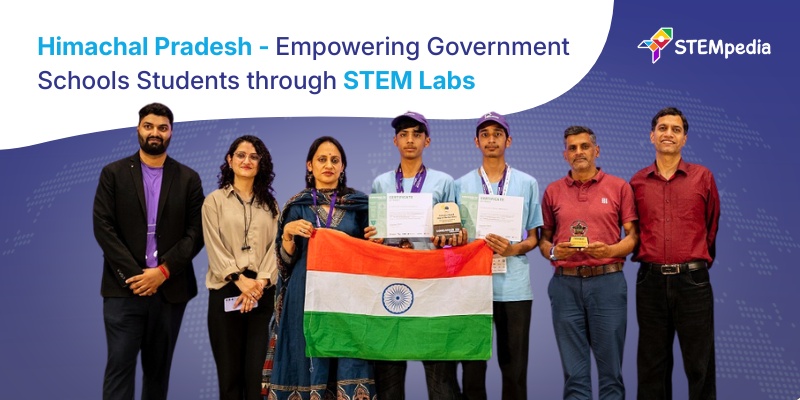
The biggest milestone came when Team Himtech from Himachal Pradesh represented India at Codeavour 7.0 International in Jakarta and won the Innovator Award for their Smart Dam Monitoring and Alerting System.
This is the story of how students from Himachal Pradesh turned local challenges into global innovation through STEM Labs.
STEMpedia in Collaboration with Samagra Shiksha Himachal Pradesh
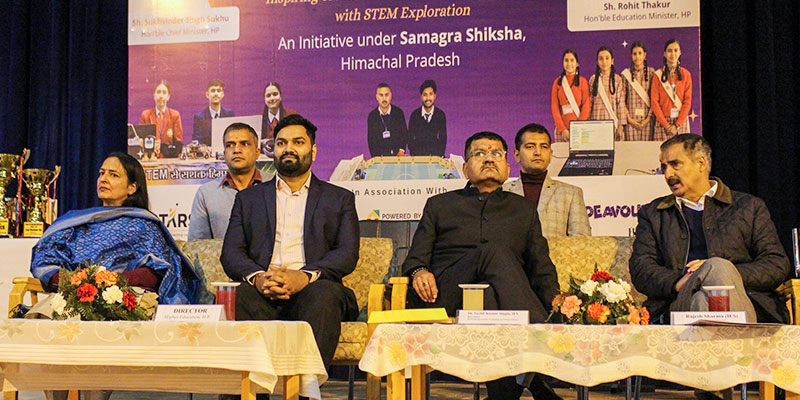
STEMpedia, in collaboration with Samagra Shiksha Himachal Pradesh, implemented the Inspiring Creative Minds for Future Innovation with STEM Exploration Project to strengthen STEM education in government schools. The initiative created a state-wide ecosystem of STEM learning through coding, AI, robotics, virtual labs, teacher training, and innovation activities, enabling students to develop practical skills and solve real-world problems.
The project was designed as a state-level STEM education intervention for government schools. It supported students from Classes 6 to 12 and focused on improving learning outcomes, building scientific thinking, strengthening digital skills, and promoting innovation.
The initiative reached:
| Metric | Outcome |
| Schools Covered | 700 Government Schools |
| Districts Covered | 12 Districts |
| Blocks Covered | 137 Blocks |
| Grades Covered | Classes 6 to 12 |
| Students Impacted | 170,000+ |
| Teachers Impacted | 1,400+ |
| Project Timeline | March 2025 – April 2026 |
The programme included proficiency testing, virtual laboratory deployment, 21st-century skills bootcamps, teacher training, LMS-based monitoring, maker-style learning activities, STEM exhibitions, and innovation challenges.
It was not only about giving students access to technology. It was about giving them a platform to think, build, test, improve, and present.
Building the Foundation with a Statewide STEM Proficiency Test
Before students moved into STEM Labs, bootcamps, hackathons, and innovation challenges, a statewide STEM Proficiency Test was conducted to assess their readiness for STEM learning.
The assessment was conducted for students of Classes 6 to 12 across government schools in Himachal Pradesh. It covered Science and Mathematics through multiple-choice questions and was delivered in both OMR-based and online formats.
The test evaluated students:
- Conceptual understanding
- Application-based problem-solving
- Analytical thinking
- Computational reasoning
- Pattern recognition
- Real-world application skills
More than 170,000 students participated in the assessment. Approximately 75–80% of students qualified, demonstrating proficiency in foundational STEM concepts and readiness for advanced learning in coding, artificial intelligence, robotics, and extended reality.
Building the Foundation: STEM Labs, AI Robotics Learning, and Hands-On Innovation
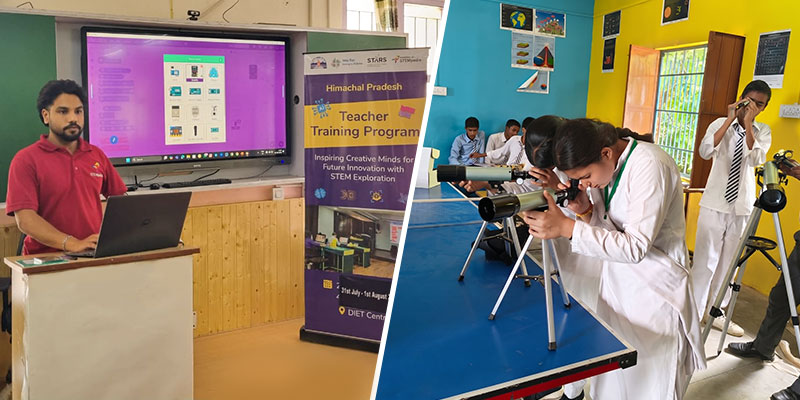
The Himachal Pradesh STEM Exploration Project was built as a complete ecosystem rather than a one-time workshop. It created a pathway where students could first explore concepts, then build projects, and finally showcase their ideas on larger platforms.
- Virtual Labs for Practical Learning: Virtual laboratories helped students perform experiments and simulations across Science, Mathematics, and related subjects. This made practical learning accessible even in schools where physical lab access was limited. For government schools in remote and hilly regions, virtual labs helped bridge a major gap by making experimentation more visual, repeatable, and student-friendly.
- Coding, AI, and XR Bootcamps: Students participated in structured bootcamps focused on coding, artificial intelligence, and extended reality. These sessions helped them build computational thinking, creativity, digital confidence, and problem-solving skills. The bootcamps also created a strong foundation for future AI Robotics Lab activities, where students could apply coding logic, automation, sensors, and emerging technologies to real-world challenges.
- Teacher Capacity Building: Teachers were trained in digital pedagogy, PictoBlox, block coding, Python programming, AI, machine learning, LMS usage, and XR-based learning tools. This helped them guide students more confidently through hands-on projects and innovation activities. A STEM Lab becomes truly effective only when teachers are confident enough to run it. This project focused on building that long-term capacity.
- LMS-Based Monitoring: A Learning Management System was used for content access, progress tracking, assignment submission, and implementation monitoring. This helped maintain consistency across schools and districts, especially in geographically challenging regions. Together, these interventions created the foundation for students to participate in STEM exhibitions, maker fairs, hackathons, and national innovation platforms.
State STEM Hackathon: Ground-Level Innovation from 12 Districts
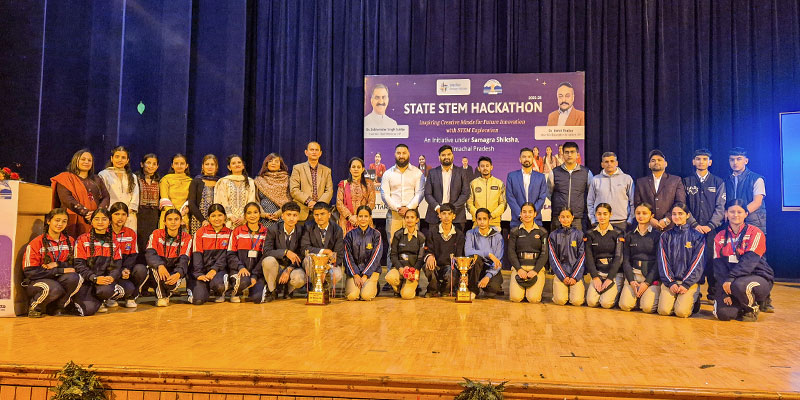
The State STEM Hackathon in Shimla marked a major turning point in the students’ innovation journey.
A total of 36 teams from all 12 districts showcased innovative solutions to real-world challenges. These teams represented the best ideas emerging from classrooms across the state.
The hackathon themes encouraged students to think about health, sustainability, environment, movement, accessibility, and community well-being:
- Healthy Minds, Healthy Life
- Sustainable Eating, Healthy Living
- Clean Planet, Healthy People
- Move More, Live More
- Tech for Wellness, Equity for All
Students developed projects that addressed the real needs of Himachal Pradesh — farming, disaster management, emergency healthcare, road safety, landslide detection, smart mobility, environmental care, and assistive technology.
The event showed that when students are given the right structure and opportunity, they do not simply participate. They observe their surroundings, identify problems, and build solutions that matter.
Projects Rooted in Himachal’s Real Challenges
The strongest projects were deeply connected to Himachal’s geography and community needs.
A team from Kinnaur created a Smart Farming Model to support farmers with sensor-based monitoring, smart irrigation, and farm security. Students from Shimla developed a Smart Portable Stretcher to improve emergency medical support in remote and hilly regions. Students from Mandi designed an Automatic Dam Gates and Monitoring System to help prevent flood-related risks through early warning and automated control.
Other students developed solutions for landslide detection, smart shoes, automatic pill dispensing, anti-sleep alarms for drivers, traffic safety, smart toilets, and sustainable farming.
These were not random school models. These were student-led responses to problems that directly affect life in Himachal Pradesh.
From State STEM Hackathon to Codeavour 7.0 Nationals
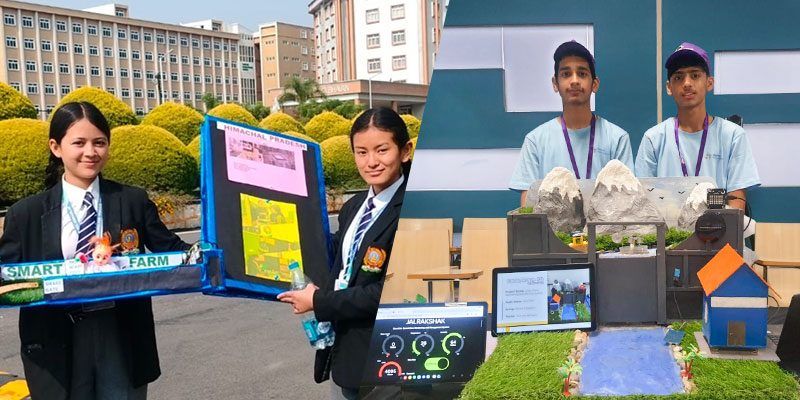
From the State STEM Hackathon, the top-performing teams advanced to Codeavour 7.0 Nationals in Bengaluru.
The three key projects that represented Himachal Pradesh at the national level were:
- Automatic Dam Gates and Monitoring System: A disaster-preparedness project focused on dam safety, early alerts, and automatic gate control.
- Smart Portable Stretcher: A healthcare project designed to support emergency patient transportation in remote and hilly regions.
- Smart Farming Model: A sustainable agriculture project that uses sensors and automation for smarter farm monitoring and resource management.
These projects stood out because they combined local relevance with practical technical execution. They reflected the core purpose of STEM Labs and AI Robotics Labs: helping students build solutions that connect classroom learning with real-world impact.
For many students, Codeavour Nationals was their first opportunity to present their ideas on a larger platform, interact with other young innovators, and see how their school-level learning could compete nationally.
Team Himtech – From Himachal to the International Stage
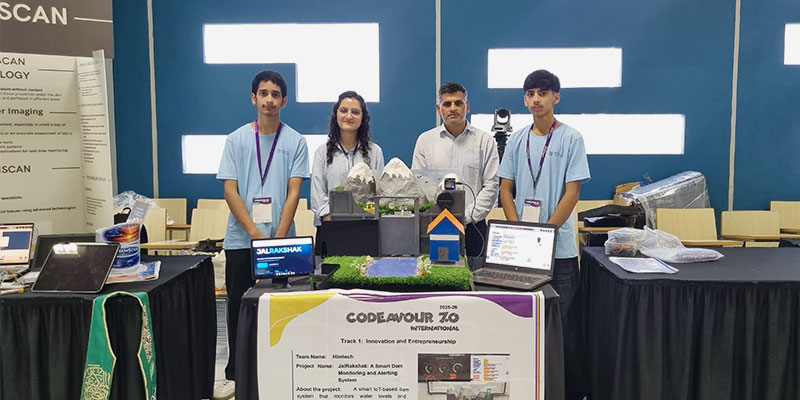
The journey reached its highest point when Team Himtech represented Himachal Pradesh and India at Codeavour 7.0 International in Jakarta, Indonesia.
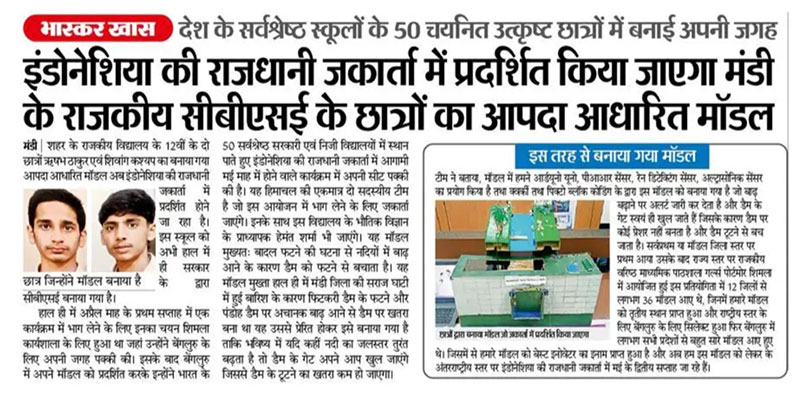
The team members, Rishabh Thakur and Shivank Kashyap, presented their Smart Dam Monitoring and Alerting System, mentored by Hemant Kumar.
Their project addressed a serious challenge for hilly and flood-prone regions. Manual dam monitoring and gate operation can cause delays during emergencies. Their system proposed a smarter way to monitor dam conditions, provide alerts, and support automatic response during high-risk situations.
At the international stage, their idea earned the Innovator Award for Out-of-the-Box Idea.
This recognition was not just a win for one team. It was a moment of pride for Himachal Pradesh, for government school students, and for every student who believes that innovation can begin anywhere.
Why AI and Robotics Labs Matter for Government School Students
AI and Robotics Labs are not only about machines, coding, or competitions. They help students develop the ability to observe a problem, break it into smaller parts, design a solution, test it, improve it, and present it confidently.
For government school students, this kind of learning creates a major shift. It builds:
- Problem-solving skills
- Computational thinking
- Creativity and innovation
- Confidence with technology
- Collaboration and communication
- Awareness of real-world applications
- Readiness for future careers in STEM, AI, robotics, and emerging technologies
Through STEMpedia’s AI and robotics learning approach, students do not remain passive users of technology. They are becoming creators of technology.
This is also where the idea of a STEMpedia Activity Center becomes important. A STEMpedia Activity Center, also known as an AI Robotics Lab, provides students with a structured space to explore coding, robotics, AI, machine learning, electronics, sensors, and project-based learning practically and engagingly.
Where Resources Were Limited, Potential Was Not
From the remote areas of Himachal Pradesh, these students proved that limited resources are no barrier to global innovation.
Their journey shows what happens when students receive the right mix of access, guidance, training, and opportunity. A student does not need to come from a large city or a premium private school to solve a meaningful problem. They need someone to open the door.
STEM Labs did that.
They gave students a place to explore.
Teachers gave them direction.
The hackathon gave them a platform.
Codeavour gave them the stage.
And the students gave Himachal Pradesh a reason to believe in its young innovators.
What This Success Story Proves
The Himachal Pradesh STEM Labs Success Story proves that government school students can become innovators when learning becomes practical, local, and meaningful.
- This success demonstrates that students in remote and hilly regions do not lack ideas — they only need the right platforms. STEMpedia provides these platforms through well-equipped STEM Labs, AI Robotics Labs, and Activity Centers.
- It shows that STEM Labs can transform curiosity into working prototypes.
- It highlights how AI Robotics Labs and STEMpedia Activity Centers help students build confidence with technology.
- It emphasizes that teacher training and structured mentorship are essential for long-term impact.
- It proves that solutions to local problems can gain global recognition.
Most importantly, it shows that when students are given the right tools through STEMpedia, they begin to see themselves differently
Not just as learners.
As creators.
As problem-solvers.
As innovators.
In a Nutshell
The Inspiring Creative Minds for Future Innovation with STEM Exploration Project empowered 170,000 students and 1,400 teachers across 700 government schools in 12 districts of Himachal Pradesh.
Through STEM Labs, AI and robotics learning, virtual learning, coding, XR bootcamps, teacher training, maker activities, STEM exhibitions, and the State STEM Hackathon, students moved from learning concepts to building practical solutions.
At the State STEM Hackathon in Shimla, 36 teams from 12 districts showcased ideas addressing real-world challenges. The top teams advanced to Codeavour 7.0 Nationals in Bengaluru. From there, Team Himtech — Rishabh Thakur and Shivank Kashyap, mentored by Hemant Kumar, represented Himachal Pradesh at Codeavour 7.0 International in Jakarta and won the Innovator Award for Out-of-the-Box Idea for their Smart Dam Monitoring and Alerting System.
This is the story of how Himachal’s students turned ideas into innovations.
The future of Himachal is not only being taught in classrooms. Students are building it.
Want to Bring a Similar STEM Programme or AI Robotics Labs to Your School?
STEMpedia works with governments, CSR initiatives, schools, education foundations, and learning centres to design, implement, and sustain large-scale STEM, coding, AI, robotics, XR, and innovation programmes.
From curriculum and teacher training to LMS monitoring, student bootcamps, STEM exhibitions, hackathons, robotics competitions, AI Robotics Lab setup, and STEMpedia Activity Center models, STEMpedia helps create scalable learning ecosystems that produce measurable outcomes.
Frequently Asked Questions
- What is the Himachal Pradesh STEM Exploration Project?
The Inspiring Creative Minds for Future Innovation with STEM Exploration Project is a STEM education initiative implemented by Samagra Shiksha Himachal Pradesh and Agilo Research Pvt. Ltd. to strengthen STEM learning in government schools through virtual labs, coding, AI, XR, teacher training, LMS monitoring, and innovation activities. - How many schools and students were impacted?
The project covered 700 government schools across 12 districts of Himachal Pradesh, impacting around 170,000 students from Classes 6 to 12. - What was the State STEM Hackathon?
The State STEM Hackathon was a statewide innovation challenge in Shimla where 36 teams from 12 districts showcased projects addressing real-world problems in Himachal Pradesh. - Which projects advanced to Codeavour 7.0 Nationals?
The top projects included the Automatic Dam Gates and Monitoring System, Smart Portable Stretcher, and Smart Farming Model. - Who represented Himachal Pradesh at Codeavour 7.0 International?
Team Himtech, represented by Rishabh Thakur and Shivank Kashyap, represented Himachal Pradesh and India at Codeavour 7.0 International in Jakarta.