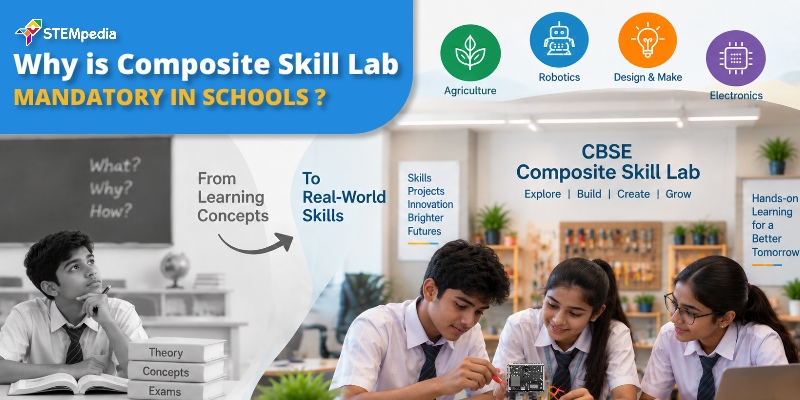
In schools, knowing a concept and applying it in a real situation are two different experiences.
A student can study electricity without building a circuit, learn agriculture without growing a plant, or understand technology without creating a working solution.
This gap between theory and practical application is one of the main reasons CBSE introduced the concept of the Composite Skill Lab (CSL).
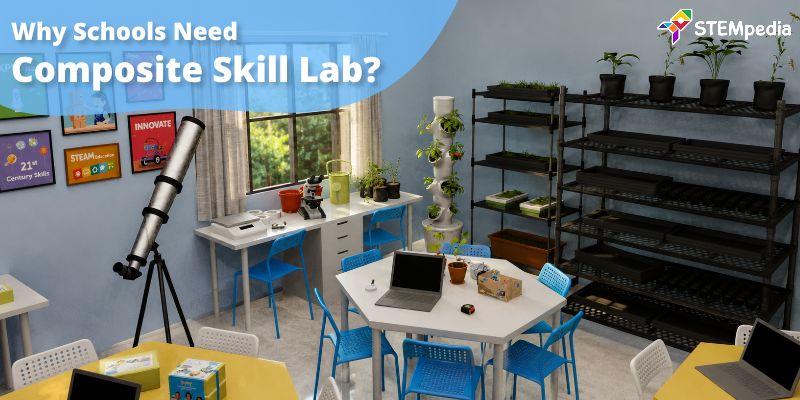
The Composite Skill Lab is not simply another laboratory added to school infrastructure. It is designed as a dedicated environment where students can learn skills, work with tools, create projects, solve problems, and explore different career pathways.
CBSE made Composite Skill Labs mandatory because effective skill education requires more than textbooks and curriculum. Students need a physical space where practical learning can happen.
This guide explains why Composite Skill Labs became mandatory, what CBSE expects from schools, and how this requirement connects with the larger vision of skill-based education.
Why Did CBSE Make Composite Skill Labs Mandatory?
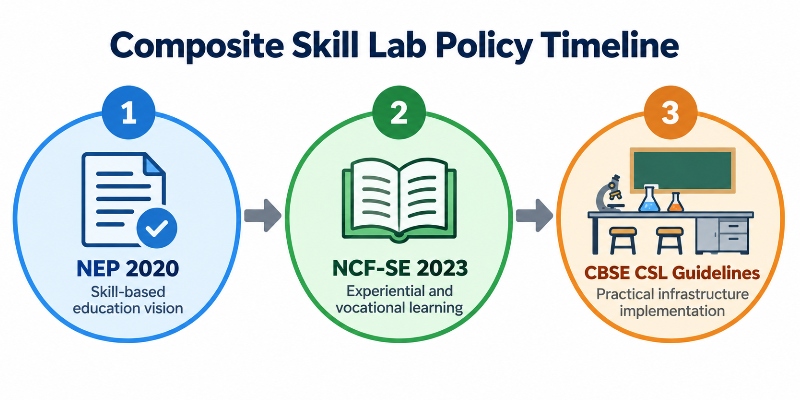
The CSL mandate is not an independent infrastructure decision. It is part of a larger transformation in Indian education.
The journey can be understood through three stages:
NEP 2020 → NCF-SE 2023 → CBSE Composite Skill Lab Requirement
NEP 2020: Bringing Skill Education into Mainstream Learning
The National Education Policy (NEP) 2020 highlighted the importance of integrating vocational education with mainstream schooling.
Traditionally, academic education and vocational education were often treated as separate pathways.
NEP 2020 aimed to change this approach by encouraging students to gain exposure to:
- Practical skills
- Vocational experiences
- Real-world applications
- Industry-related learning
- Career exploration
The idea was simple:
Education should not only prepare students to understand the world. It should prepare them to participate in and improve it.
NCF-SE 2023: Turning Skill Education into Practical Experience
The National Curriculum Framework for School Education (NCF-SE) 2023 strengthened this vision by emphasizing:
- Experiential learning
- Hands-on activities
- Project-based learning
- Exposure to different forms of work
- Skill development from middle school onwards
However, practical learning requires infrastructure.
Students cannot truly learn manufacturing, electronics, agriculture, healthcare or technology without access to:
- Tools
- Equipment
- Workspaces
- Demonstration areas
- Project materials
This created the need for a dedicated learning environment — the Composite Skill Lab.
CBSE Circular Skill-75/2024: The Beginning of the CSL Mandate
On 23 August 2024, CBSE issued Circular No. Skill-75/2024 regarding the establishment of Composite Skill Labs in CBSE schools.
The circular highlighted an important challenge:
Many schools wanted to implement skill education, but they did not have the necessary infrastructure and equipment required for meaningful hands-on learning.
To address this gap, CBSE mandated that affiliated schools establish Composite Skill Labs with the required equipment and machinery.
The purpose was to help schools:
- Provide practical skill training
- Support project-based learning
- Improve career exploration opportunities
- Develop entrepreneurial abilities
- Connect classroom knowledge with real-world applications
CBSE Skill-13/2026 Guidelines: Defining the Implementation
CBSE later released Circular Skill-13/2026 on 20 March 2026, providing detailed guidelines for establishing and operationalising Composite Skill Labs.
The guidelines clarified:
- Infrastructure requirements
- Space planning
- Equipment approach
- Safety considerations
- Implementation timelines
The focus was not simply creating a room filled with machines.
The goal was to create an adaptable learning environment where students can engage in different skill sectors and forms of work.
Why Does CBSE Need a Dedicated Skill Lab?

A common question among school leaders is:
“Why can’t existing classrooms, computer labs, or science labs handle skill education?”
Skill education requires a different type of learning environment.
A traditional classroom is designed mainly for:
- Explanation
- Discussion
- Written activities
A skill lab is designed for:
- Building
- Testing
- Experimenting
- Making
- Troubleshooting
- Improving
For example:
A student learning electronics should not only read about circuits.
They should:
- Select components
- Connect a circuit
- Test the output
- Identify errors
- Modify the design
This requires a dedicated practical workspace.
What Problems Does the Composite Skill Lab Solve?
1. It Converts Theory into Experience
Students move from:
Reading → Understanding → Building → Testing → Improving
Learning becomes active instead of passive.
2. It Makes Vocational Education Accessible
Earlier, practical skills were often introduced only through specialised courses.
The CSL brings skill exposure into mainstream school education.
Students can explore:
- Technology
- Agriculture
- Design
- Healthcare
- Manufacturing
- Services
3. It Helps Students Discover Career Interests
Many students choose careers without experiencing different fields.
A CSL allows students to discover:
- Engineering interests through robotics
- Technology interests through AI and coding
- Environmental interests through agriculture projects
- Service interests through healthcare activities
4. It Develops Future-Ready Skills
Modern workplaces require more than subject knowledge.
Students need:
- Problem-solving
- Creativity
- Collaboration
- Design thinking
- Communication
- Adaptability
A CSL creates opportunities to develop these skills through projects.
Conclusion
The Composite Skill Lab became mandatory because practical learning cannot happen through curriculum alone; students need the right environment, tools, and opportunities to apply knowledge.
CBSE’s CSL initiative transforms skill education from an idea into a structured learning experience where students can build, experiment, solve problems, and explore future careers.
For schools, the goal is not only to complete a compliance requirement before 2027. It is to create a space where students move from learning about the world to actively creating solutions.