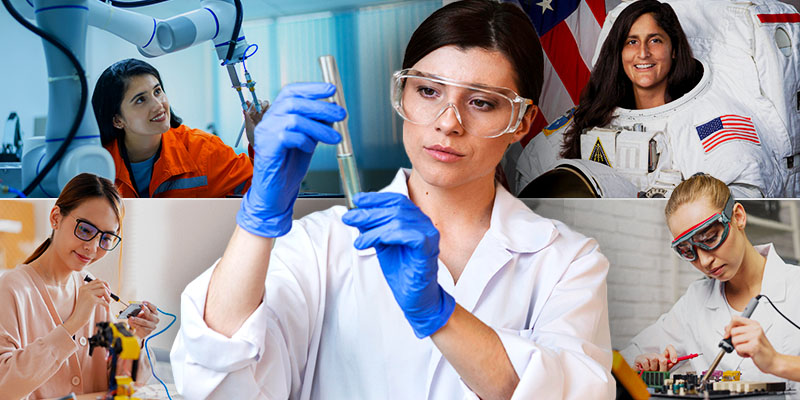
STEM has often been termed as something progressive and ahead of its time. Still, a crucial thread has been consistently frayed, overlooked and undervalued even today; the contributions of women. From hidden “computers” catalyzing space missions to brilliant theorists denied Nobel Prizes, women have always been there, boldly asserting. Today, as we celebrate more visible pioneers, a distinct paradox emerges: women in STEM are still struggling to secure recognition.
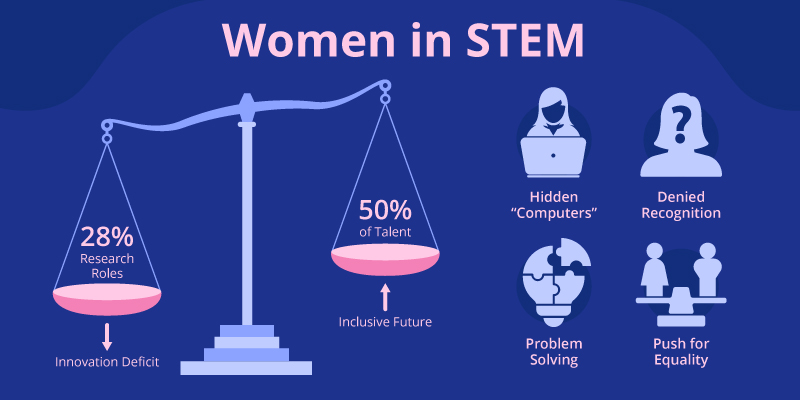
Women hold only about 28% of STEM research positions, and that figure declines further in fields such as technology and engineering globally. This isn’t just about the equality; it’s a critical innovation deficit. The article explores how half of the world’s problems remain unresolved when half the workforce is underrepresented. It discusses the historical erasure, systemic barriers, and tangible costs associated with this gap, highlighting the global movement striving to build a truly inclusive future in STEM.
Women Who Built Science From the Shadows
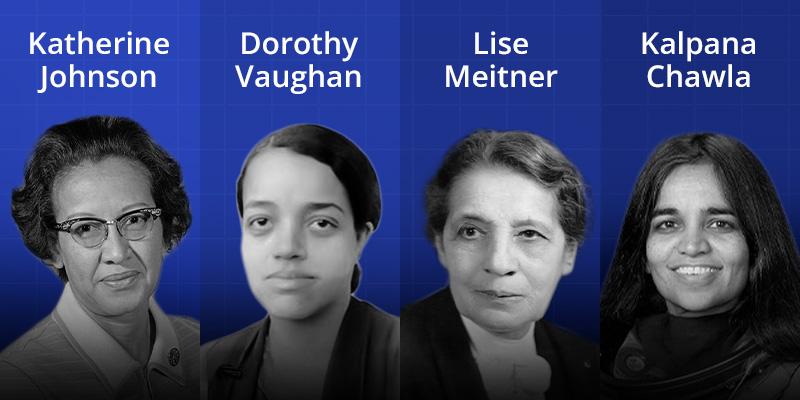
For decades, women in STEM worked behind the scenes, shaping some of humanity’s greatest scientific breakthroughs without recognition. From space exploration to nuclear physics, their intellectual labour powered progress while their names remained absent from mainstream history.
- Members of NASA’s West Area “Computers,” including Katherine Johnson, Dorothy Vaughan, and Mary Jackson, formed the mathematical and scientific backbone of early U.S. space missions. Their work enabled safe orbital flights, accurate navigation, and mission planning for programs that defined the Space Race.
- Katherine Johnson’s orbital mechanics calculations were essential for John Glenn’s historic flight and later Moon missions, establishing mathematical reliability in human spaceflight.
- Dorothy Vaughan pioneered NASA’s transition from human computing to machine programming by mastering and teaching FORTRAN, laying the foundation for modern scientific computing at the agency.
- Mary Jackson’s work in aerodynamics research directly contributed to aircraft and spacecraft design, while her advocacy created pathways for women and minorities in engineering roles.
- Kalpana Chawla and Sunita Williams carried this legacy forward into space itself, advancing microgravity research, long-duration spaceflight, and ISS missions, while becoming global role models for women in aerospace.
- In physics, Lise Meitner’s theoretical explanation of nuclear fission transformed modern science, yet recognition went to her male colleague, marking one of history’s most cited cases of gender bias in scientific credit.
Together, these women shaped aviation, space exploration, computing, and nuclear science, not as supporting figures, but as core architects of progress. Their invisibility did not diminish their impact, but it did shape a system in which women’s contributions were normalised as background labour rather than as leadership.
Program for Encouraging Women in STEM
A robust global movement is tackling these challenges on multiple fronts. Communities and organisations like WiSTEM and Women for STEM are building close-knit networks for education, mentorship, and outreach.
This helps girls and genderqueer students with the visibility and exposure they deserve. UNESCO is also working to encourage greater female participation in science and technology, which are central to sustainable development agendas.
A change taking its shape at the vanguard of evolving systems to tackle these challenges, fueled by:
- Communities like Women for STEM India are working at the grassroots level to connect schoolgirls with professionals and resources to bridge the inspiration gap.
- Organizations like Women in STEM (WiSTEM) are crucial volunteer-led networks for education, mentorship, and outreach, providing girls and genderqueer students with the support and visibility they need.
- International bodies like UNESCO work tirelessly to encourage greater female participation in science, which is central to sustainable development agendas.
-
AnitaB.org‘s Grace Hopper Celebration (GHC): The world’s largest gathering of women and non-binary technologists. Student scholarships and the virtual “Hopper” community are key access points.
- To address these disparities, companies are gradually adopting policies such as pay equity audits, robust parental leave, flexible work environments, and strict anti-harassment protocols to retain talent.
-
Girls Who Code continues to expand its free clubs, summer immersion programs, and college loops globally.
-
Black Girls Code: Focuses on providing tech education for young Black girls through workshops and camps in coding, robotics, and game design.
-
TechGirlz: Empowers middle-school girls by offering free, hands-on workshops run by industry professionals.
-
National Girls Collaborative Project (NGCP): A massive network that brings together organizations across the US to collaborate and share best practices for engaging girls in STEM.
We have been hearing a lot about these kinds of initiatives, but what can we do to empower more women in STEM
Nurturing Innovation and Providing a Platform to Girls in STEM
Platforms like Codeavour play a vital role in shaping the future of inclusive innovation. As a global AI, coding, and robotics competition, Codeavour empowers students to solve real-world problems through technology, creativity, and critical thinking, building not just skills, but confidence and purpose in young innovators.
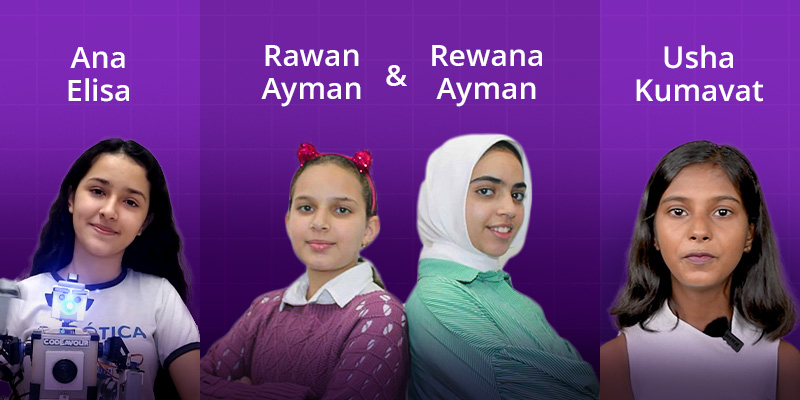
A key part of this mission is the Girls in STEM Award, which recognises young female innovators who demonstrate exceptional talent, originality, and impact in STEM. At Codeavour International, this award celebrated inspiring achievers, including Elif Gamze Ulutaş, Ramadan Aseeyah Garba, and Sani Hafsa Laila, young leaders whose ideas reflect the power of access, opportunity, and belief in girls’ potential.
By creating spaces where girls are seen, supported, and celebrated, Codeavour contributes meaningfully to building a more inclusive, future-ready STEM ecosystem.
Ana Elisa’s Spirometer that Won Codeavour
Ana Elisa, a young innovator from Brazil, exemplifies how student creativity can drive real-world impact. Her award-winning project, the Digital Incentive Spirometer, won Codeavour 2022 for its AI-powered approach to respiratory therapy, supporting conditions like COVID-19, asthma, and bronchitis through interactive digital engagement. Using PictoBlox, she later became a finalist at the ISEF, demonstrating that young minds, when empowered with the right tools, can build technology that truly changes lives.
Tech-Savvy Teens Revolutionising Health with AI and Winning Big
Revana and Rawan, two young innovators from Egypt, won first prize at Codeavour 2022 with their AI-powered project, “For a Good Health.” Designed to promote healthy posture during screen use, the solution employs AI and machine learning to detect poor sitting habits and guide users toward better ergonomics, demonstrating how young minds can use technology to address everyday health challenges.
Usha Kumawat’s Uphill Journey to Success is Inspiring Girls in STEM
Usha Kumavat, a Grade IX student from Goa, embodies resilience and determination. Overcoming financial and logistical barriers, she reached the Codeavour 5.0 International Competition in Dubai with the support of her mentor and community, proving that with guidance, opportunity, and collective support, young talent can rise beyond circumstances and access global innovation platforms.
In a Nutshell
In the face of adversity and widespread resistance, women in STEM are demonstrating remarkable resilience. Be it the hidden figures of history or modern graduate women navigating workplace bias, the challenge persists. Mainstreaming women in STEM is not solely a matter of fairness; it is essential to building technology that serves all of humanity and solves the biggest problems of our time. By advocating for inclusive education, requesting unbiased placements, and celebrating every achievement, we are not just opening doors for women; we are also unlocking a future of limitless innovation.