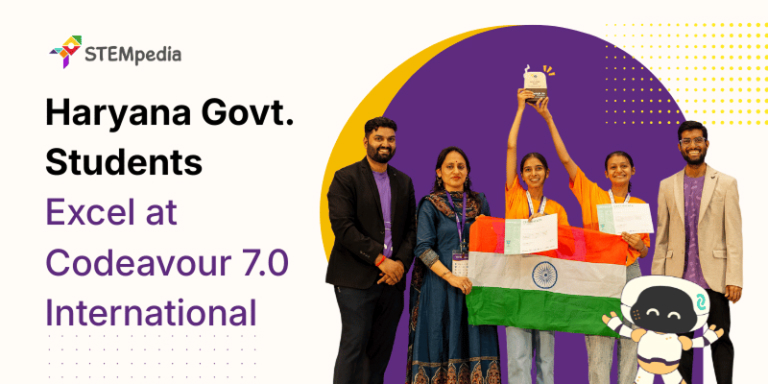
In April 2024, classrooms across Haryana transformed.
Students in government schools, many from rural and semi-urban backgrounds, sat down in front of their first robotics kit, opened a tablet loaded with PictoBlox, and started building things that actually worked.
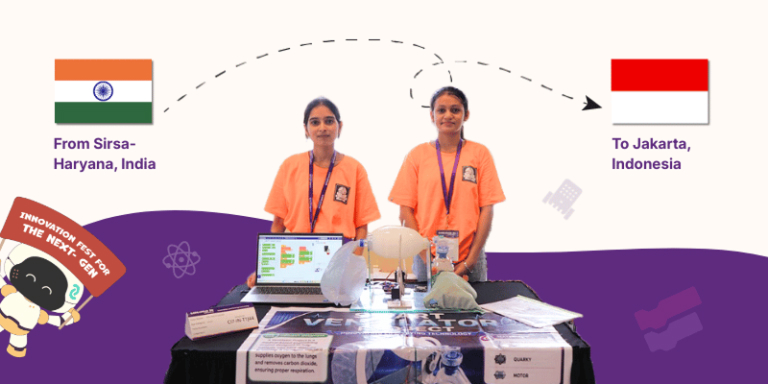
A group of students recreated scenes from the Mahabharata using robots and animations. A student in Gurugram programmed a smart school door with voice alerts. Students in Sirsa built a weather monitoring system. These projects helped prepare students for hackathons, innovation challenges, and robotics competitions. Two years later, two of those students from a government girls’ school in Sirsa stood on an international stage in Jakarta, Indonesia, representing India against 1,700 innovators from 22+ countries.
These were not students from elite private schools. These were Class 6 to 12 students in government schools across 13 districts of Haryana. Many had never touched a robotics kit before. Many came from modest family backgrounds where technology education had simply never been presented to them.
This is their story and the story of a state that decided the future should be accessible to everyone.
The partnership that made it possible
The Department of School Education, Government of Haryana, in collaboration with STEMpedia, officially launched the STEM Lab initiative on April 1, 2024. The mandate was clear: establish functional, technology-enabled STEM labs in 50 government schools across 13 districts, serving students from classes 6 to 12.
This was not a pilot. It was a state-level commitment backed by infrastructure investment, dedicated field implementation teams, teacher training programmes, and a two-year monitoring and evaluation framework aligned directly with the National Education Policy 2020.
The initiative was built around one clear belief: that quality technology education should not be the privilege of students whose families can afford private schools. Every child in a government school deserves the same future-ready skills.
| Metric | Outcome |
| Number of Schools | 50 Government Schools |
| Districts Covered | 13 Districts of Haryana |
| Target Grades | Classes 6 to 12 |
| Students Empowered | 20,000+ |
| Teachers Trained | 150+ |
| Expert Trainers Deployed | 12 District-Level STEMpedia Experts |
| Project Launch Date | April 1, 2024 |
| Student Projects Created | 1,500+ |
What was Built — The Lab Infrastructure
The labs were not symbolic. They were functional, fully equipped, and designed for daily use. Lab sessions supported 30–40 students per session in rotational timetables, maintaining smooth multi-grade operations. The labs were designed for daily hands-on use, bridging the gap between theoretical knowledge and real-world applications.
Each of the 50 schools received:
- 16 tablets were provided by the Government. Students used these tablets alongside Quarky kits and STEMpedia’s curriculum to begin coding, AI, and robotics projects from the very first session.
- Quarky AI and Robotics kits, complete with sensors, motors, and DIY project materials for practical learning.
- Learning Management System (LMS) for teachers and students to track progress, assign tasks, and submit projects.
- All curriculum materials were provided in Hindi, allowing deeper comprehension and engagement across all grades.
“This lab is not just technology. It is the beginning of a different way of thinking about what government school students can learn and what they can build.”
For more information, visit: STEM Labs with AI and Robotics in Haryana Government Schools.
Codeavour 7.0 — Haryana Students on the National and International Stage
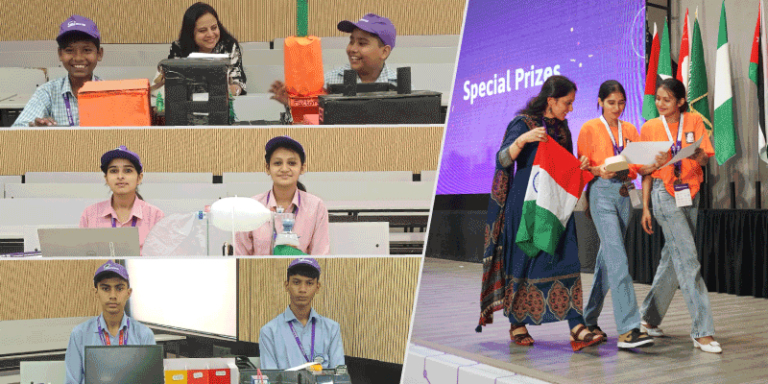
Across India, students participate in state-level hackathons, coding competitions, AI challenges, robotics contests, and innovation events to showcase their creativity and problem-solving skills. Through Haryana’s STEM Lab initiative, students gained hands-on experience in coding, artificial intelligence, robotics, and real-world project development, preparing them to confidently participate in these competitive platforms. Their journey from classroom projects to national and international recognition is best reflected through their remarkable performance in Codeavour 7.0.
Codeavour is India’s largest international AI, coding, and robotics competition for school students, organised by STEMpedia. It challenges students to build original projects using AI, machine learning, robotics, and coding, judged on creativity, technical merit, and real-world impact. Students compete through regional rounds, advance to national finals, and the best teams represent their country at the international championship alongside innovators from across the globe.
For government school students in Haryana, Codeavour was not just a competition. It was the first time many of them stood on a stage beyond their school gate and showed the world what they had built.
The Haryana Government Schools in Codeavour 7.0
The participation numbers from Codeavour 7.0 tell a story that deserves careful reading.
- Orientation Participants: 5,919
- Regional Competition: 1,635 students
- National Finalists: 6 students
- International Representatives: 2 students — Prachi and Harshita from GGSSS Sirsa Mela Ground
Three Teams from Haryana Qualified for the National Stage
- The Teach Squad
Students: Prachi and Harshita
STEMpedia Mentor: Pawan Kumar (District STEM Instructor, Sirsa) - Young Code Warriors
Students: Paras Suhag and Prince Ahlawat
STEMpedia Mentor: Garima Dhall (District STEM Instructor, Rohtak) - Think Coders
Students: Shiva and Yogesh Saini
STEMpedia Mentor: Manisha (School Mentor) and Pankaj Lohan (District STEM Instructor, Ambala)
International Achievement:
Among these teams, Prachi and Harshita from The Teach Squad went the further, representing India at the Codeavour 7.0 International Championship in Jakarta, Indonesia, where they competed against young innovators from 22+ countries.
Prachi and Harshita — The Story From Sirsa to the World Stage
Prachi and Harshita, Class XI students from GGSSS Sirsa, Mela Ground, made history as part of The Teach Squad, mentored by Pawan Kumar, STEMpedia’s district STEM instructor. From modest backgrounds and with no prior experience in AI or robotics, they built an AI-driven ventilator prototype inside their government school STEM lab using PictoBlox and Quarky. The project demonstrated both technical skill and genuine empathy — addressing a real-world healthcare challenge that matters in low-resource medical settings.
Their journey began at the school-level competitions, where they showcased their AI-driven ventilator project and emerged as top performers. They then advanced through the regional and state-level rounds across Haryana, earning a place at the Codeavour 7.0 India Nationals held at GITAM University, Bengaluru, where they secured the national title. Their success at the national stage earned them the opportunity to represent India at the Codeavour 7.0 International Championship in Jakarta, Indonesia, competing against 1,700 young innovators from 22+ countries.
This achievement underscores the potential of government schools to nurture talent at the highest levels. As Principal Paramjit Kaur stated:
“Government schools can nurture students to reach the highest levels of success, regardless of their socio-economic background.”
What Students Built — Projects Rooted in Culture and Community
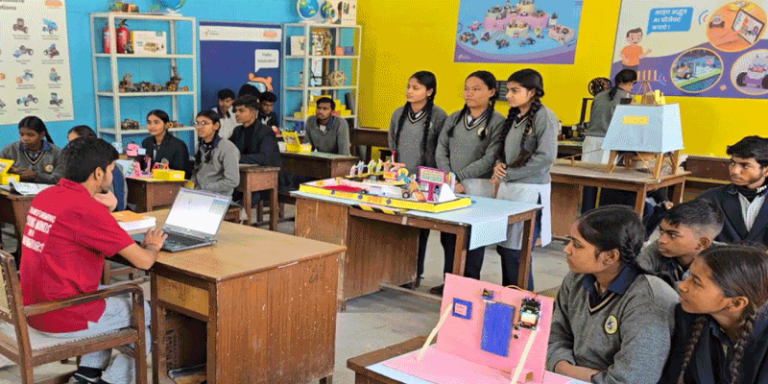
Across 50 government schools, students built over 1,500+ projects. What made them genuinely remarkable was their rootedness in Haryana’s culture, environment, and community.
- Robo Kushti: Interactive wrestling arenas with sensors and RGB lighting, blending Haryana’s traditional wrestling heritage with technology.
- Mahabharata at Kurukshetra: Dramatised mythological episodes using Quarky robots and PictoBlox animations.
- River Waste Collector Bots: Mobile robots designed to address local environmental concerns.
- Smart School Doors: Automated doors with sensors and voice alerts for safety.
- Weather Monitoring Systems: IoT-based temperature and humidity monitoring for farming communities.
These projects exemplify hands-on learning that is culturally relevant, socially responsible, and technically rigorous.
8,800+ Girls — The Number Behind the Headlines
The Haryana AI and Robotics Lab initiative placed a strong focus on equitable STEM access, aligning with the visions of Beti Bachao Beti Padhao, Digital India, and NEP 2020. The goal was not just to introduce technology but to break social and gender barriers in education, ensuring that girls from rural and semi-urban government schools had the same opportunity to learn, build, and innovate as anyone else.
Of the 20,000+ students who participated, more than 8,800 were girls.
Before the labs existed, schools reported 7 to 10 girls in any technology activity. After implementation, it grew to 25 to 30 per session, a threefold increase.
Schools Where Girls Led
Several schools in the programme are exclusively girls’ institutions, and their participation numbers tell the story most clearly:
- GGMSSSS Railway Road, Karnal — 420 girls, 100% female AI and robotics participation
- GGSSS Sirsa Mela Ground — 662 girls accessed AI, robotics, and coding for the first time at the same school that produced India’s international representatives
- GGSSS Faridabad Old — all 181 participants were girls
- GGSSS Bidhal, Sonipat — all participants were girls
Prachi and Harshita’s victory in Jakarta was not an isolated event. It was built on the foundation of 662 girls who walked into the same lab before them, sat at the same benches, and proved to each other that this space belonged to them. When the conditions are right, girls do not need to be encouraged toward technology. They simply need access to it.
“When the government places a robotics kit in front of a girl in a village school in Haryana, it is not giving her a toy. It is giving her permission to become a builder. That permission changes everything.”
What this proves — For Haryana and for India
The Haryana Government School success story with STEMpedia proved something that needed proving, not just in Haryana, but for every state deciding whether government school students deserve this kind of investment.
It proved that government school students from rural districts, from agricultural families, from schools that never previously had a robotics kit, can learn AI, build ventilators, win national championships, and represent India internationally.
It proved that teacher training, when delivered with ongoing daily field support rather than a single event, permanently changes what a classroom produces.
It proved that a curriculum in a student’s own language is not a compromise. It is the condition under which real learning happens.
It proved that daily monitoring accountability keeps programmes alive long after inauguration day.
And it proved that equity in education is not a slogan. It is a lab. A kit. A trained STEM instructor named Pawan Kumar. And two girls from Sirsa who went to Jakarta and came back knowing exactly who they were.
In a Nutshell
50 schools. 13 districts. 20,000+ students, 1,500+ projects, 150+ teachers. 5,919 students at Codeavour orientations. 6 national finalists. Two international representatives.
And two girls from a government school in Sirsa who stood in Jakarta, holding a ventilator prototype they built by hand, representing a country of 1.4 billion people.
That is not a statistic. That is a generation that sees itself differently.
The Haryana success story with STEMpedia is not an infrastructure story. It is a story about what happens when a government invests in its most underserved students, when teachers show up with tools and purpose, and when two girls are finally given the opportunity they always deserved.
When young people are given the tools to build, they build things that change what everyone around them believes is possible.
“The future belongs to creators, builders, and innovators. Through this initiative, Haryana is ensuring that the future is not reserved for the few; it belongs to everyone.”
The story of Haryana is not finished. It has just begun. Still Building!
Want to Bring a Similar Programme to Your State or Organisation?
STEMpedia works with state governments, CSR initiatives, education foundations, and school networks to design, implement, and sustain AI and robotics education programmes at scale, from lab setup and curriculum to teacher training, competition frameworks, and transparent monitoring.
We have done it in Haryana. In Goa. In Himachal Pradesh. In Madhya Pradesh. In Gujarat. Internationally in Colombia and Africa. We know what makes these programmes produce results, and we build accordingly.
Frequently Asked Questions
- What is the Haryana STEM Lab initiative?
The Haryana STEM Lab initiative is a collaboration between the Department of School Education, Government of Haryana, and STEMpedia, launched in April 2024 to establish AI, robotics, and coding labs in 50 government schools across 13 districts of Haryana. The programme serves students from Classes 6 to 12 and is aligned with NEP 2020.
- How many students have been impacted by the programme?
Over 20,000+ students across 50 Haryana government schools have gained hands-on STEM learning exposure. This includes 8,800+ girls, marking a major step towards equitable STEM access.
- What technology and tools are used in the labs?
Each lab includes 16 government-provided tablets, Quarky AI and Robotics kits, an LMS, and Hindi-English curriculum materials for students and teachers.
- How were teachers trained for the programme?
Over 150 government school teachers were trained across 13 districts in three-day structured training programmes. After training, dedicated STEMpedia district-level expert trainers provided ongoing weekly school visits, mentoring, and field support throughout the year.
- What kinds of projects did students build?
Students created over 1,500+ projects, including weather monitoring systems, river waste collector bots, smart school door automation, cultural projects like Robo Kushti and Mahabharata at Kurukshetra, and AI-based smart systems.