For many CBSE schools, the biggest question around Composite Skill Lab setup is not only what to build, but also how to build it while leveraging existing infrastructure.
Many schools already have an Atal Tinkering Lab, an IT Lab, a Makerspace, a Home Science Lab, or a single-sector skill lab. These spaces already contain tools, equipment, furniture, computers, electronics, and learning resources that can support skill education.
The good news is that schools do not always need to start from zero.
As per CBSE’s Composite Skill Lab guidelines, existing school spaces can be leveraged for the delivery of some skill subjects. However, schools must clearly understand the difference between leveraging an existing lab and converting it into a full Composite Skill Lab.
This blog explains how schools can practically use ATL, IT Labs, Makerspaces, and other spaces for Composite Skill Lab implementation, what can be reused, what cannot be converted, and how STEMpedia helps schools set up a CBSE-aligned, future-ready Composite Skill Lab.
If you are new to Composite Skill Labs (CSL), we recommend reading our detailed blog: KFTL Composite Skill Lab by STEMpedia – Practical AI, Robotics & STEM Skills.
It will give you a clear understanding of what a Composite Skill Lab actually is and how STEMpedia makes the setup simple, practical, and effective.
Answers at a Glance
Click each question to quickly understand the key CBSE Composite Skill Lab requirements and how existing school infrastructure can support the setup.
Contact STEMpedia →
What is a Composite Skill Lab for CBSE schools?
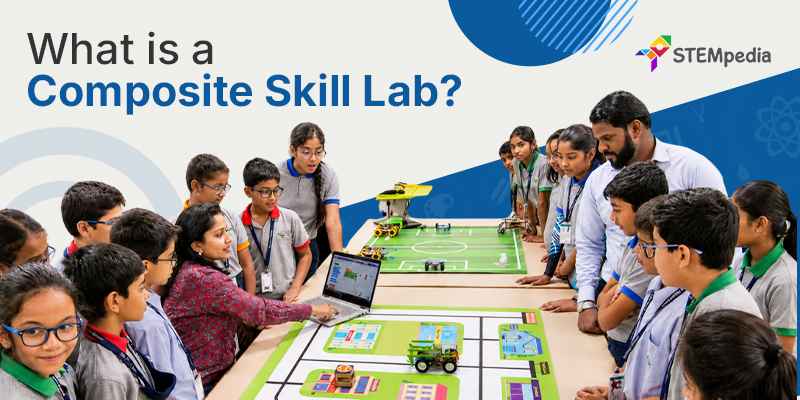
A Composite Skill Lab is a flexible, multi-sector, hands-on learning space designed to support skill and vocational education in CBSE schools.
Unlike a traditional subject-specific lab, a Composite Skill Lab is not limited to one area such as computers, robotics, or science experiments. It supports practical learning across multiple skill sectors and helps students connect classroom concepts with real-world work.
A well-designed Composite Skill Lab helps students:
- Work with tools and equipment
- Build practical projects
- Explore skill-based learning
- Understand real-world applications
- Develop problem-solving and critical thinking skills
- Learn through hands-on activities and project-based tasks
The Composite Skill Lab supports the vision of NEP 2020 and NCF-SE 2023, which emphasize the integration of skill and vocational education into mainstream school education.
The Three Forms of Work in a Composite Skill Lab
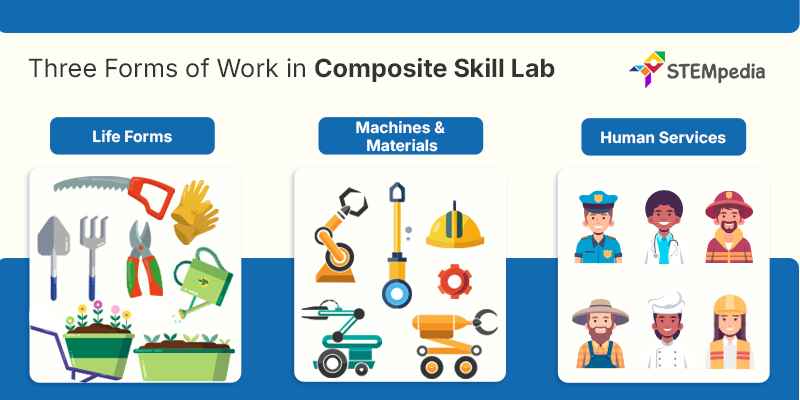
A Composite Skill Lab is designed to give students exposure to different types of hands-on and practical learning. CBSE’s framework focuses on three forms of work: Work with Life Forms, Work with Machines and Materials, and Work on Providing Human Services.
These three areas help students explore skills related to nature, technology, tools, digital systems, and people-centric services. Therefore, existing spaces such as ATL, IT Labs, Makerspaces, or single-sector labs can support CSL implementation, but they cannot be considered a complete Composite Skill Lab unless they meet CBSE’s full requirements for space, tools, safety, storage, and multi-sector learning coverage.
Why Should Schools Leverage Existing Labs and Spaces?
Setting up a Composite Skill Lab requires careful planning. Schools need to think about space, tools, storage, safety, curriculum, timetable, teacher readiness, and budget.
If a school already has useful infrastructure, it can reduce duplication and cost by integrating those existing resources into the larger skill education plan.
Existing labs can help schools:
- Reduce unnecessary equipment purchases
- Use available tools more effectively
- Save space
- Improve lab utilization
- Connect skill education with existing school infrastructure
- Start implementation faster
- Build a stronger project-based learning ecosystem
However, schools must ensure that this is done correctly. Reusing a space does not mean simply renaming it as a Composite Skill Lab.
Can ATL Be Used for Composite Skill Lab?
Yes, but with limitations.
An Atal Tinkering Lab, or ATL, is a dedicated innovation and hands-on learning workspace established under the Atal Innovation Mission by NITI Aayog. It is designed to promote tinkering, creativity, design thinking, computational thinking, physical computing, robotics, electronics, and real-world problem-solving among students.
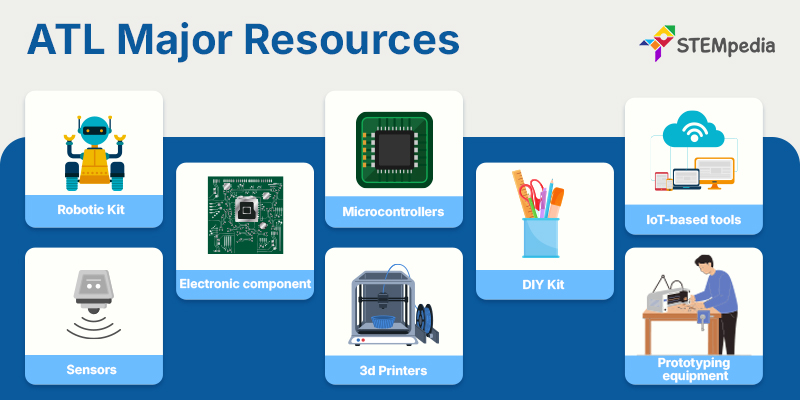
These resources are useful for the Work with Machines and Materials category in Composite Skill Lab implementation. Schools can use ATL tools for Mechatronics, Electronics, Robotics, Coding, AI, Automation, and related project work.
However, an ATL cannot be converted into a Composite Skill Lab because it is a government-funded project created for a specific purpose. The ATL can support CSL implementation, but it cannot replace the full CSL requirement.
ATL vs CSL: What Schools Must Understand
| Point | ATL | Composite Skill Lab (CSL) |
|---|---|---|
| Full Form | Atal Tinkering Lab | Composite Skill Lab |
| Main Purpose | Innovation, tinkering, robotics, and prototyping | Multi-sector skill and vocational education |
| Funding | Government-supported under the Atal Innovation Mission | School-funded or independently arranged by the school |
| Focus Area | Mainly STEM, robotics, electronics, and innovation | Three forms of work: Life Forms, Machines and Materials, and Human Services |
The right approach is not to replace CSL with ATL. The right approach is to integrate ATL as a supporting space within the broader Composite Skill Lab ecosystem.
How can Schools Use Existing IT Labs, Makerspaces, and ATLs for CSL Implementation?
Yes. Existing IT Labs, Makerspaces, and Atal Tinkering Labs (ATLs) can support Composite Skill Lab implementation, but each has a different role and limitations.
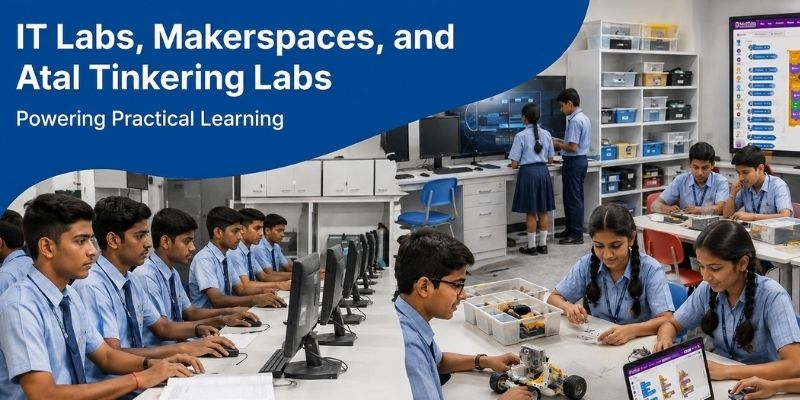
- IT Lab: An IT Lab can be leveraged for digital and computer-based skill subjects such as coding, artificial intelligence, finance, graphic design, animation, multimedia, AVGC, digital literacy, data handling, and other software-based activities. However, it cannot be treated as a full Composite Skill Lab because it does not cover the complete range of hands-on, multi-sector skill activities required under the CSL framework.
- Makerspace: A Makerspace is often the closest existing setup to a Composite Skill Lab. It may include fabrication tools, work tables, electronics, prototyping materials, 3D printers, carpentry tools, design tools, and sometimes apparel or media-related resources. A Makerspace can support several CSL activities and may be converted into a Composite Skill Lab only if it meets CBSE’s space, safety, infrastructure, storage, tool, and operational requirements.
- Atal Tinkering Lab (ATL): As explained earlier, an ATL can support technology-based CSL activities such as robotics, electronics, coding, AI, IoT, prototyping, and automation. However, it cannot replace a full Composite Skill Lab. Schools can use ATL resources as supporting infrastructure, while ensuring that the final CSL setup meets CBSE’s complete multi-sector requirements.
How Can Other Existing Spaces Support CSL Implementation?
Schools can also leverage existing spaces such as School Gardens, Home Science Labs, and single-sector labs to support specific skill subjects.
- Open Gardens and Green Spaces: Schools can use open gardens and green spaces for agriculture, gardening, floriculture, plant nursery, hydroponics, and sustainability-related activities. However, the tools should still be stored safely in the Composite Skill Lab. Some planning, documentation, and project work may also happen inside the CSL.
- Home Science Lab: A Home Science Lab can support food production, baking, nutrition, and related skill activities if it has the required equipment. However, it cannot be converted into a full Composite Skill Lab because it has a specialized use, especially for higher classes.
- Existing Single-Sector Skill Labs: Some schools already run skill subjects such as Beauty and Wellness, Retail, Automotive, Healthcare, Apparel, or other vocational subjects.
These labs can be leveraged for the relevant skill subject. However, if the lab was set up through government funds, special funds, or CBSE-specific funding for a particular purpose, it cannot be converted into a Composite Skill Lab.
Existing Lab Usage Guide for Schools
| Existing Space | Can It Be Leveraged? | Can It Be Converted into CSL? | Best Use in CSL Ecosystem |
| ATL / Agile ATL | Yes | No, if government-funded | Electronics, Mechatronics, Robotics, Prototyping |
| IT Lab | Yes | No | Coding, AI, Finance, Graphic Design, Animation, Digital Literacy |
| Makerspace | Yes | Yes, if CBSE specifications are met | Prototyping, fabrication, woodwork, design, electronics |
| Open Garden / Green Space | Yes | No | Agriculture, gardening, sustainability, hydroponics |
| Home Science Lab | Yes | No | Food production, baking, nutrition-related skill activities |
| Single-Sector Skill Lab | Yes | Only if funding and specifications allow | Relevant skill subject support |
Why Choose STEMpedia for Composite Skill Labs?
STEMpedia supports schools in planning, setting up, and running CBSE-aligned Composite Skill Labs with a practical and outcome-focused approach.
STEMpedia helps schools with:
- Infrastructure Planning: Designing the lab layout based on available space, selected skill sectors, student strength, storage, safety, and workstation needs.
- Existing Infrastructure Audit: Identifying how ATL, IT Labs, Makerspaces, and other spaces can be reused, upgraded, or integrated to reduce cost and avoid duplication.
- Tools and Equipment Selection: Choosing durable, safe, and curriculum-aligned tools for AI, robotics, electronics, coding, prototyping, agriculture, digital skills, and other skill areas.
- AI, Coding, and Robotics Integration: Adding future-ready learning experiences through robots, automation, IoT, AI projects, sensors, and hands-on technology activities.
- Curriculum and Learning Resources: Providing structured lesson plans, student activities, teacher guides, assessments, and project-based learning resources.
- Teacher Training: Training teachers to use the lab confidently, manage practical sessions, follow safety practices, and guide student projects.
- Student Showcases: Supporting project exhibitions, skill fairs, innovation challenges, portfolio presentations, and student-led demonstrations.
With this complete support, STEMpedia helps schools create Composite Skill Labs that are practical, active, safe, and useful throughout the academic year.
Want to Set Up a CBSE Composite Skill Lab with STEMpedia?
STEMpedia helps schools establish, operate, and sustain Composite Skill Labs aligned with CBSE guidelines, NEP 2020, and NCF-SE 2023.
From auditing existing infrastructure and designing smart lab layouts to providing tools, curriculum, teacher training, AI robotics integration, and implementation support, STEMpedia helps schools turn the CBSE Composite Skill Lab requirement into a practical, future-ready learning ecosystem.
Conclusion
Existing labs can reduce cost, but the real impact comes from turning them into a working skill-learning ecosystem. A strong CSL should not just meet CBSE requirements; it should help students build, test, explore, and present real projects.
With STEMpedia, schools can move from basic compliance to a future-ready Composite Skill Lab powered by hands-on learning, teacher training, AI, robotics, and structured project-based activities.