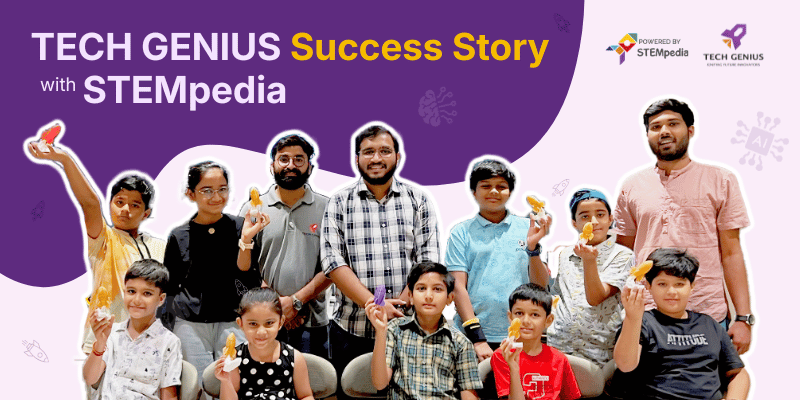
A Room Full of Future Innovators
Every innovation begins with curiosity. At Tech Genius Institute in Gandhinagar, Gujarat, students are not simply sitting in rows and copying notes. They are connecting wires, writing code, testing robots, breaking things, fixing them, and figuring out why.
That is the learning environment Jinal Patel and Het Patel (Founder and Co-Founder of Tech Genius) set out to create, and for the past few years, it has been running every single day.
About Tech Genius Institute
Tech Genius Institute, based in Gandhinagar, Gujarat, offers AI, robotics, coding, 3D printing, drone technology, IoT, and game development courses for students from Class 3 to Class 12. It runs online classes, offline batches, and school-based programmes across the region.
The founding team brings engineering depth to every part of what they teach. Het Patel graduated in Mechanical Engineering from L.D. College of Engineering. Co-founder Jinal Patel holds a B.Tech from SVNIT, Surat. CTO Janak Mevada, also from SVNIT, leads the institute’s design, 3D printing, and robotics work.
The common thread across all three is a refusal to teach technology from a distance. At Tech Genius, students work with the real thing.
What Inspired Tech Genius to Focus on AI and Robotics?
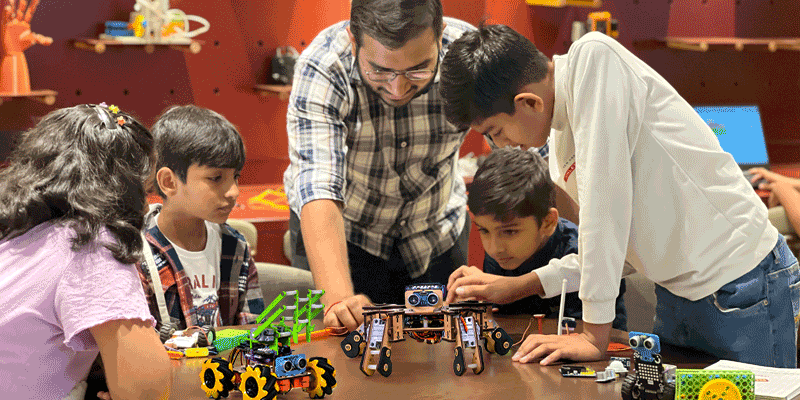
Jinal Patel did not start Tech Genius because of a market gap or a business plan. He started it because of a question that bothered him: why are students learning about technology without ever getting to work with it?
Most school environments teach students to read about how a robot moves, how a sensor detects an object, or how AI helps a machine make decisions. Very few give students the chance to actually find out for themselves.
That gap was the starting point for Tech Genius. The idea was simple: give students the space, the tools, and the time to ask real questions and find real answers.
Questions like:
- How does a robot move?
- How does a sensor detect an object?
- How can coding control a machine?
- How does AI help robots make decisions?
- How can technology actually solve a problem someone has?
When students work through questions like these with their hands, not just their eyes, something changes in how they think. That shift is what Tech Genius was built around.
Why Should Students Learn AI, Robotics, and Coding Early?
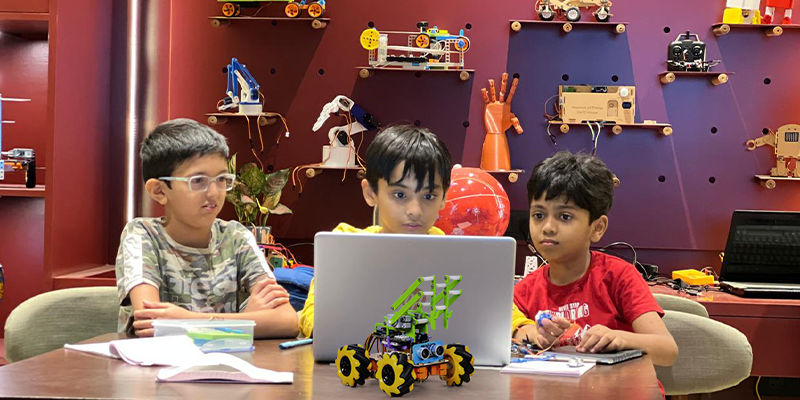
This is a question Het Patel and Jinal Patel get from parents regularly, and their answer has never changed.
The skills that matter most in any future engineering, design, healthcare, business, or anything else are not subject-specific. They are the ability to break a problem into parts, think step by step, try something, learn from what happens, and try again.
Robotics and coding build those skills naturally, because the feedback is immediate and honest. If the code is wrong, the robot does not move. If the sensor is wired incorrectly, nothing works. Students learn to debug, adjust, and persist not because they are told to, but because they want to see their project work.
The skills Tech Genius students develop through this process include:
- Problem-solving and logical thinking
- Creativity and design thinking
- Confidence with technology
- Teamwork and communication
- An innovation mindset that carries into every subject
Starting early matters because these habits of mind take time to build. A student who has spent two years building and fixing projects thinks differently from one who has only read about them.
How Tech Genius Discovered STEMpedia?
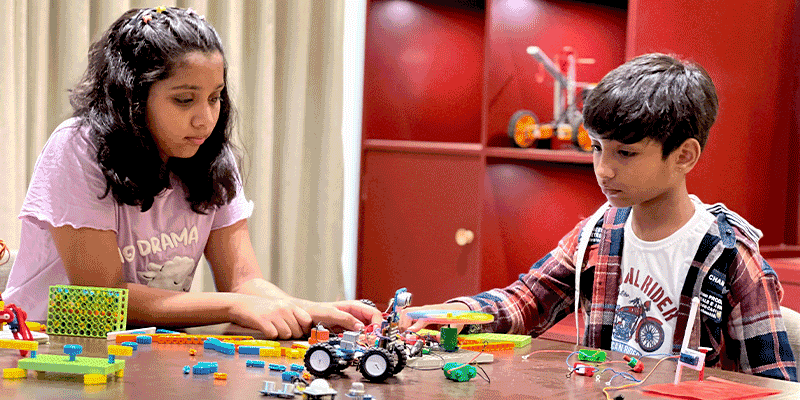
When Tech Genius was finding the right tools for its lab, the requirement was specific: something that could grow with students, from complete beginners to advanced builders, without switching platforms or losing continuity.
That is when the team came across Quarky and PictoBlox.
What stood out was not a feature list. It was the fact that students could get started on day one and still find new things to build three years later. The platform did not get in the way of the learning; it got out of the way and let students focus on their ideas.
That has been the core of the Tech Genius and STEMpedia relationship for three years.
How does STEMpedia fit into the Tech Genius Learning Model?
Tech Genius does not introduce STEMpedia tools as products. They introduce them as instruments, the way a music teacher introduces an instrument before a student plays their first song.
Quarky is the physical companion. Students use it to build robots, attach sensors, control movement, and bring their coded logic into the physical world. It handles everything from basic line-following to object detection and AI-based automation, which means students at different levels are always working on something that challenges them appropriately.
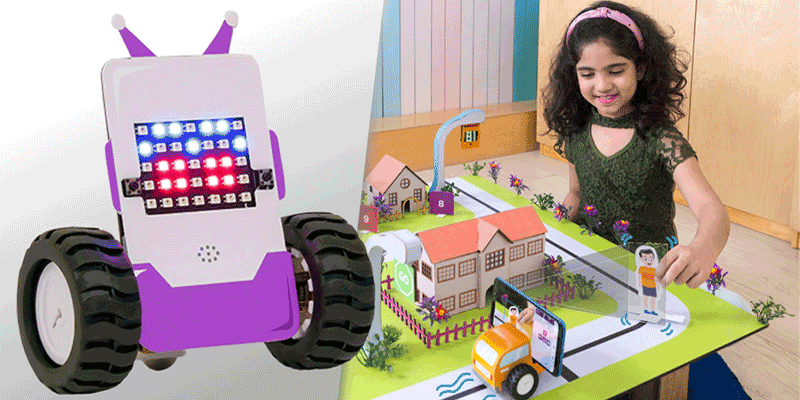
PictoBlox is where the coding happens. Younger students begin with visual block-based coding that is intuitive enough to get working results on the first day. As they advance, the same platform supports Python, so there is no transition, no starting over, just a natural progression.
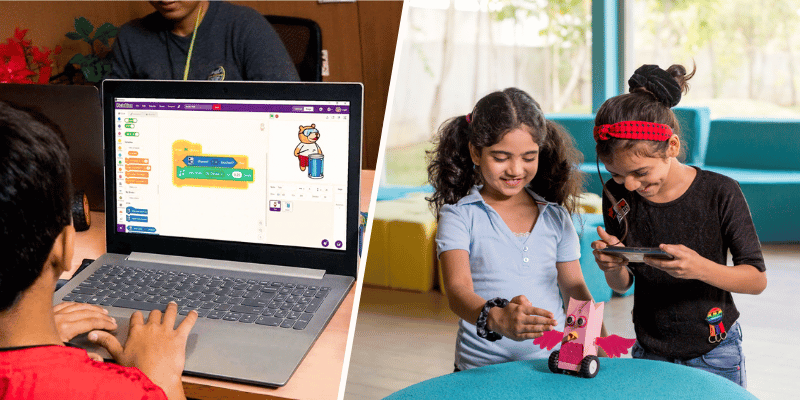
The combination means a student who joins Tech Genius at age 8 and stays through Class 10 is always working within a system that meets them where they are. That continuity is rare, and it is one of the reasons Tech Genius has stayed with STEMpedia for three years without looking elsewhere.
“Students could actually see their code come to life. That connection between thinking and doing — that is what makes the difference.” — Jinal Patel, Co-Founder, Tech Genius Institute
Learning Inside the AI and Robotics Lab
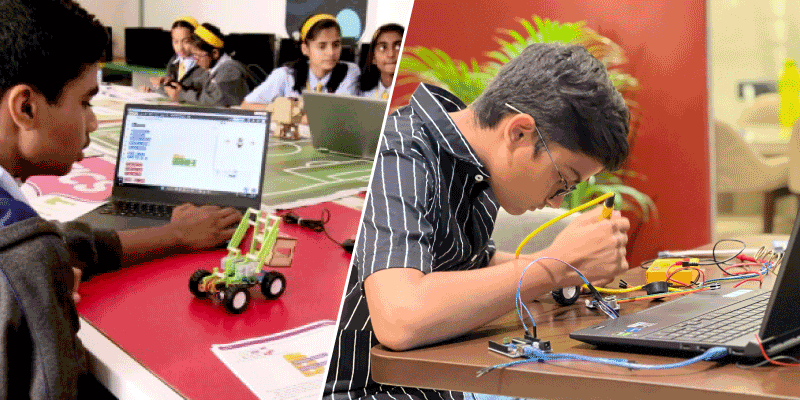
The lab at Tech Genius is not a showroom. It shows the signs of real-use components on tables, projects at different stages, and students huddled over a robot trying to figure out why it turns left instead of right.
A typical session moves through setup, a brief demonstration, hands-on building time, testing, troubleshooting, and a short sharing round at the end, where students explain what they built and what surprised them.
What the lab experience looks like in practice:
- Students work on individual and team-based robotics challenges
- Projects are built across multiple sessions, not completed in one class
- Mistakes are treated as part of the process, not failures
- Students document and present their completed projects
- Advanced students often help newer ones, which deepens their own understanding
The environment is deliberately open-ended enough that two students working on the same challenge can arrive at completely different solutions. That variety is intentional. It reflects what real problem-solving looks like.
Projects That Stand Out
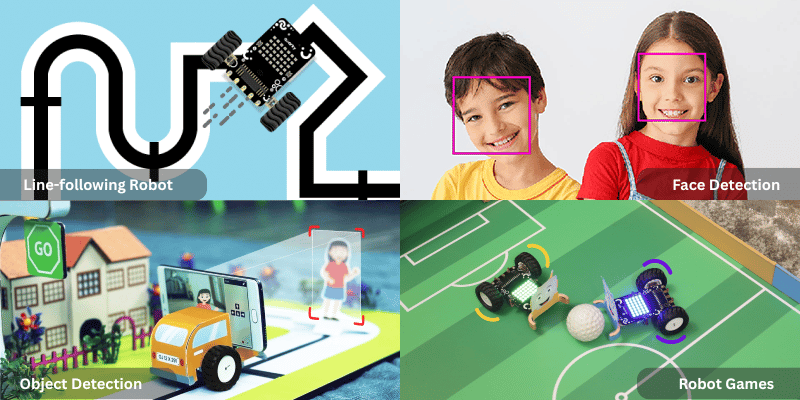
Over three years, students at Tech Genius have built a wide range of projects. Some are classic challenges, like line-following robots, obstacle-avoidance systems, where the real learning is in the debugging, not the concept.
Others have been more ambitious: AI-based smart robots that respond to commands, sensor-driven automation models, and object detection projects where students have to think carefully about how they train the system.
The projects that stand out most are not always the most technically complex. They are the ones where a student came in with a problem they cared about and built something that addressed it, even if imperfectly. That ownership changes the quality of attention students bring to the work.
Some highlights from the lab over the years:
- Line-following and maze-solving robots
- Obstacle-avoidance and path-planning models
- AI-based face recognition and object detection activities
- AI-Based Traffic Management System Using Vehicle Detection
- Sensor-based automation and smart environment projects
- Robotics models built for the ROBODAY 2024 competition at Gandhinagar International Public School, featuring events like Roborace, Pacepilot, Pick and Place, and Tree Replanter
What Growth has Tech Genius Observed in Students?
The most visible change in students at Tech Genius is not in what they know. It is in how they carry themselves.
A student who joins hesitantly, afraid to touch the components, second-guessing every step, and then spends a few months building, breaking, and rebuilding things, comes out different. They ask sharper questions. They try things without waiting for permission. They explain their thinking out loud because they have had to do it in class.
Across three years of running the lab, the Tech Genius team has observed consistent patterns in student development:
- Curiosity increases — students start asking questions that go beyond the session’s topic
- Confidence with technology grows — hesitation around hardware and code fades with repetition
- Logical thinking improves — students begin breaking problems down naturally
- Teamwork deepens — collaborative debugging becomes a genuine skill
- Students begin presenting their work with real confidence, not just reading from notes
The shift is gradual and cumulative. Which is why continuity matters — and why the three-year relationship with STEMpedia has supported rather than interrupted that progression.
How Parents’ Perceptions Have Evolved?
When Tech Genius first opened, some parents enrolled their children out of curiosity. They were not always sure what robotics and coding training would lead to or whether it was practical.
Over three years, that conversation has changed. Parents who initially asked “what will this be useful for?” are now describing specific changes they see at home — children who troubleshoot problems differently, who are more patient with complex tasks, who explain their thinking in steps instead of giving up when something does not work immediately.
The shift from seeing robotics as an extracurricular experiment to recognising it as a foundational capability is something Tech Genius has watched happen gradually, family by family.
Message for Parents and Students from Tech Genius
To parents: Early exposure to AI, robotics, and coding does not just build technical skills. It builds the kind of thinking that is useful in every field — the confidence to try, the patience to debug, and the ability to look at a problem and figure out where to start. The earlier students develop that, the longer it has to compound.
To students: Don’t wait until you feel ready. Every project at Tech Genius starts with someone who had no idea how to do it. Build something. See what breaks. Fix it. That cycle is not a detour from learning — it is the learning.
“The goal is to create a space where children feel confident to ask questions, try new ideas, and build something meaningful. Today’s learners can become tomorrow’s innovators.” — Jinal Patel, Co-Founder, Tech Genius Institute.
In a Nutshell
Tech Genius Institute set out to solve a straightforward problem: students should not just learn about technology — they should learn to create with it.
Three years later, the lab at Gandhinagar is proof that this works. Students who arrived uncertain are now the ones guiding their peers. Curious parents are now advocates. Schools in the region are running robotics competitions because their students have somewhere to train.
The STEMpedia tools Quarky and PictoBlox have been part of that journey from the beginning. Not as a centrepiece, but as reliable instruments that let students focus on what actually matters: the ideas, the building, and the learning that happens in between.
Want to Build a Future-Ready AI and Robotics Learning Programme?
If you are a school or institute looking to create a similar hands-on AI and robotics learning environment, STEMpedia works with institutions across India to set up structured, practical programmes that students actually use.
You can explore:
- Quarky — AI and Robotics Kit — the hands-on hardware that powers project-based learning
- PictoBlox — AI and Coding Software — download free and start coding today
- AI and Robotics Lab for Schools — complete lab setup with curriculum and training support
Frequently Asked Questions
1. What is Tech Genius Institute?
Tech Genius Institute is a technology-focused learning institute based in Gandhinagar, Gujarat, offering AI, robotics, coding, 3D printing, drone technology, and IoT courses for students from Class 3 to Class 12.
2. How long has Tech Genius been working with STEMpedia?
Tech Genius has been working with STEMpedia for over three years, using Quarky and PictoBlox as the core tools across their robotics and AI curriculum.
3. What STEMpedia products does Tech Genius use?
Tech Genius uses Quarky for hands-on robotics and PictoBlox for coding and AI activities across all student age groups.
4. Why is Quarky a good fit for student robotics training?
Quarky supports a wide range of projects — from basic movement and sensors to AI-based object detection and smart automation — which means it remains useful as students grow, without needing to switch platforms.
5. How does PictoBlox help students who are new to coding?
PictoBlox starts with block-based visual coding that beginners can use immediately, then offers a natural progression to Python for more advanced work — all within the same platform, with no disruption to the learning flow.