Schools preparing for a Composite Skill Lab (CSL) usually start with the room: space, tables, tools, and safety. But a lab does not teach anything by itself. Students and teachers need a curriculum that tells them what to do inside it.
For Classes VI–VIII, that curriculum is Kaushal Bodh.
This guide explains what Kaushal Bodh is, how it is structured, what students actually do under it, and how it fits with the Composite Skill Lab that CBSE has asked every affiliated school to establish.
Related reading:
- What Is a Composite Skill Lab? A Complete Beginner’s Guide for CBSE Schools
- Why Is a Composite Skill Lab Mandatory for CBSE Schools?
What Is Kaushal Bodh?
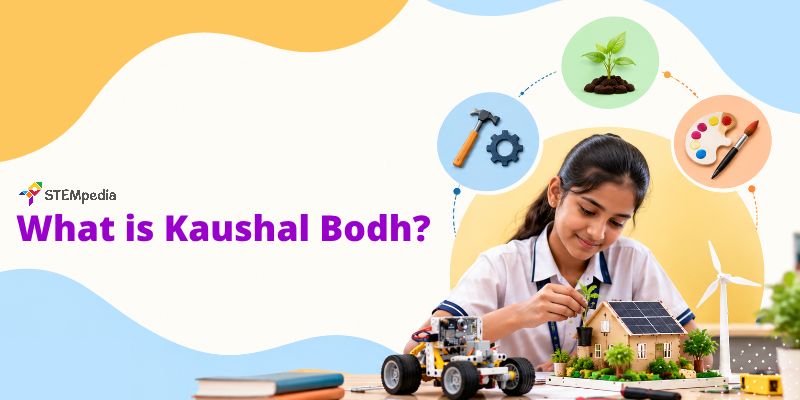
Kaushal Bodh is the skill education curriculum for Classes VI–VIII. It is developed through activity-based books that guide students and teachers through practical projects rather than theory-based lessons.
It is important to understand three points:
- It is activity-based. Students learn through projects, observation, making, reflection, and presentation.
- It is broad exposure, not early specialisation. The aim is not to train students for one job, but to expose them to different kinds of work.
- It is locally adaptable. Schools can select projects and vocations based on age group, local context, available resources, and teacher readiness.
In simple terms:
Kaushal Bodh gives the curriculum direction. The Composite Skill Lab gives the physical space to practise it.
How Kaushal Bodh Is Structured
The structure is simple and repeats every year:
- Three projects per grade, one from each Form of Work: Work with Life Forms, Work with Machines & Materials, and Work in Human Services.
- Nine projects in total across Classes VI–VIII.
- Six illustrative projects in each activity book, two per Form of Work. Schools choose one per form each year, or design their own using the project template given in the book.
- Around 30 hours per project, according to CBSE’s Kaushal Bodh curriculum framework.
- A Kaushal Mela (Skills Fair) at the end of the year, where students present their projects, learnings, and reflections. NCF-SE describes this as part of the Middle Stage design.
Projects can also connect with other subjects. For example, an agriculture project can draw on concepts from science, with relevant teachers supporting it.
If this structure looks familiar, that is by design. Kaushal Bodh and the Composite Skill Lab are both built on the three Forms of Work introduced in NCF-SE 2023. For a closer look at how a school selects its sectors within them, see How Should a School Choose Its Three CSL Domains?
Kaushal Bodh Projects Across the Three Forms of Work
Kaushal Bodh projects are designed to be practical, relatable, and multidisciplinary. They combine low-tech and high-tech learning, so that schools can begin with available resources while gradually building stronger lab infrastructure.
| Form of Work | What It Focuses On | Example Kaushal Bodh Projects |
| Work with Life Forms | Plants, agriculture, sustainability, environment and living systems | School Kitchen Garden, Biodiversity Register, Plant Nursery, School Habitat Garden, Hydroponics |
| Work with Machines and Materials | Tools, machines, electronics, coding, making and design | Maker Skills, Animation & Games, Tie & Dye, AI Assistant, Wood and Bamboo Work, Home Automation |
| Work in Human Services | People, services, finance, health, communication and community needs | School Museum, Cooking without Fire, Storytime with Puppets, Family Health Handbook, Water Audit, Creating Advertisements |
A few things stand out:
- The projects are everyday and relatable. A kitchen garden, a water audit or a family health handbook connects directly to a student’s home and community.
- They span low-tech and high-tech. Hydroponics and an AI assistant sit alongside puppetry and cooking without fire.
- They show that skill education is not only about technology. Many projects need modest equipment but a lot of planning, observation, and communication.
To see how each Form of Work can be taken further inside a Composite Skill Lab, read:
- Work with Life Forms in a Composite Skill Lab — Exploring Agriculture and Sustainability with STEMpedia
- Work with Machines and Materials in a Composite Skill Lab — AI, Robotics and ICT with STEMpedia
- Work in Human Services in a Composite Skill Lab — Finance and Entrepreneurship with STEMpedia
Kaushal Bodh and the Composite Skill Lab: How They Connect
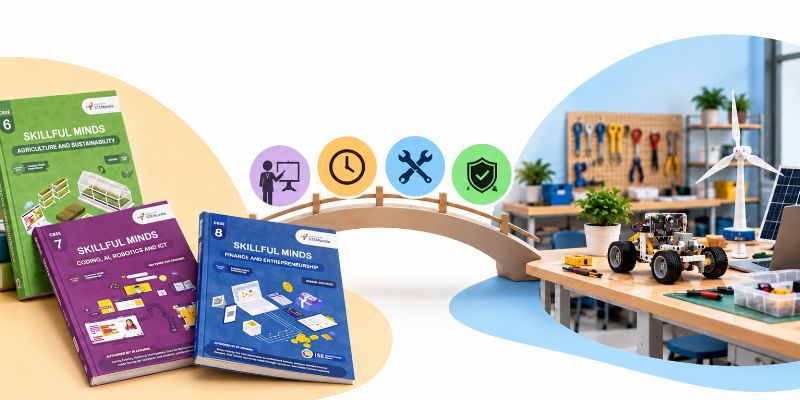
The simplest way to understand the relationship:
Kaushal Bodh is the curriculum. The Composite Skill Lab is the place where much of it is carried out.
CBSE’s guidelines list the components skill education needs: a curriculum, trained teachers, a timetable slot, a Composite Skill Lab, and industry exposure. Kaushal Bodh covers the curriculum. The CSL covers the lab. Neither works well without the other.
- A lab without the curriculum risks becoming a showpiece. Equipment sits unused because no one has decided which projects it supports.
- A curriculum without the lab pushes teachers back to chalkboard instruction. Practical projects get explained instead of done.
In practice:
- The lab supports the projects. Tools for gardening, electronics, food preparation, and simple fabrication are stored and used in the CSL, while some work, such as gardening, can also use outdoor spaces.
- The curriculum guides the lab. Which tools a school needs depends on the projects it chooses to run.
- Existing spaces still count. A school garden, ATL, IT lab, or home science lab can support relevant projects, though none of them replaces the CSL requirement. Details are in How Schools Can Use ATL, IT Labs, and Makerspaces for CBSE Composite Skill Lab Setup.
That is why planning order matters: choose the sectors and projects first, then the equipment.
Time, Teachers and Assessment
Time: NCF-SE sets aside 110 hours a year for Vocational Education at the Middle Stage, about 165 periods. Its sample timetable suggests joining periods into longer blocks, because hands-on work rarely fits a standard 40-minute slot.
Teachers: Not every school has teachers trained in vocational subjects, and NCF-SE says so openly. Locally trained resource persons can support delivery, coordinated by regular teachers who have been trained for it. The expected shift is from lecturer to facilitator: guiding, supervising safe tool use, and letting students learn through trial and error. Teacher readiness is covered in Teacher Training for Composite Skill Labs – How Schools Can Build CSL Readiness?
Assessment: NCF-SE recommends assessment based on observation, portfolios, and projects, covering values and disposition as well as skills. Written tests alone cannot capture this, so schools need a way to document student work through the year. Schools should follow the assessment scheme given in CBSE’s Kaushal Bodh curriculum framework and circulars rather than relying on secondary summaries, as reported breakdowns vary.
How STEMpedia Supports Kaushal Bodh Implementation
Kaushal Bodh tells schools what students should do. Schools still need a way to deliver it consistently: projects planned across grades, tools in the right places, teachers who are comfortable running practical sessions, and a way to record student work.
STEMpedia’s Composite Skill Lab is built around the same three Forms of Work and is designed to support that delivery. It does not replace the NCERT books. Schools using it alongside Kaushal Bodh should map each project to the books so the two stay aligned.
| What Schools Need | What STEMpedia Provides |
| Structured project delivery | Grade-wise projects, chapter plans, activity mapping and defined learning outcomes for Classes 1–10, across Agritech, Technology Enablement, and Finance and Entrepreneurship |
| Hands-on tools | CSL toolkits for each Form of Work, from smart monitoring and plant care to robotics, electronics, aeromodelling, and play-money and scenario cards, available across Basic, Medium, Large and Premium lab tiers |
| Digital learning | PictoBlox for block-based and Python coding, AI/ML, IoT and 3D design, plus an LMS with lesson plans, activity sheets, worksheets, quizzes and reports |
| Teacher readiness | Hands-on training in project delivery, tool use, safety, portfolio assessment and Kaushal Mela |
| Assessment support | Workbooks, portfolios and learning-outcome mapping to track learning beyond written tests |
| Showcase | A Kaushal Mela model in which students present projects, prototypes and portfolios |
Two design choices are worth noting for schools planning budgets and spaces:
- STEMpedia’s CSL Learning Model links the existing ICT lab, the CSL, and any ATL or makerspace into one progression from Class 1 to Class 10.
- The tiered lab options let schools begin at a compliant baseline and expand. CBSE itself gives an indicative setup cost of about ₹3–6 lakh and treats equipment lists as suggestive. A fuller breakdown is in How Much Does It Cost to Set Up a CBSE Composite Skill Lab (CSL)?
For the complete offering, see Composite Skill Lab by STEMpedia: A Complete NEP 2020 & NCF-SE Aligned Solution.
Schools can explore STEMpedia’s complete Composite Skill Lab solution:
What Schools Should Plan Now
A practical sequence for schools moving from understanding to action:
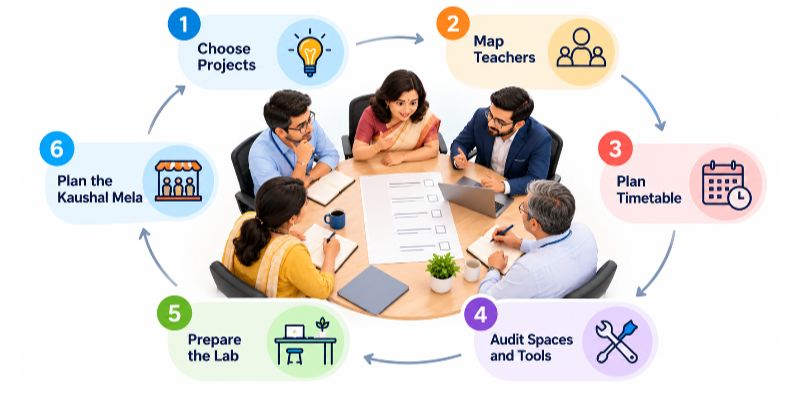
- Choose projects across all three Forms of Work for each grade, based on local context, student interest, and available resources.
- Map teachers and local resource persons to each project, and identify who needs training.
- Build the timetable around the 110-hour allocation, using longer practical blocks where possible.
- Audit existing spaces and tools before buying anything, then identify what the CSL still needs.
- Prepare the lab for the chosen projects, with safety provisions planned from the start.
- Plan the Kaushal Mela and decide how student portfolios will be documented through the year.
The related guides in this series cover the later steps:
- Composite Skill Lab Tools and Equipment for CBSE Schools
- How to Set Up a Composite Skill Lab in Phases – From Readiness to Launch
- AI in Composite Skill Lab – What CBSE Means by AI Infrastructure?
Conclusion
Kaushal Bodh gives skill education in Classes VI–VIII a clear structure: practical projects, three Forms of Work, portfolio-based learning, and student presentation through Kaushal Mela.
The Composite Skill Lab gives that curriculum the space, tools, and safe environment required for hands-on learning.
When Kaushal Bodh and the Composite Skill Lab are planned together, skill education becomes more than a compliance requirement. It becomes a working learning programme where students grow, build, serve, solve, and present.