For years, school education has largely focused on helping students understand concepts through textbooks, classroom discussions, and examinations. But understanding a concept and being able to apply it in a real situation are not always the same thing.
A student may learn about electricity without building a circuit, study agriculture without working with plants, or learn about technology without designing and testing a working solution.
This gap is what the Composite Skill Lab (CSL) aims to address.
The concept is closely connected to the direction of the National Education Policy (NEP) 2020 and the National Curriculum Framework for School Education (NCF-SE) 2023, which place greater emphasis on vocational education, practical learning, experiential learning, and exposure to different forms of work.
CBSE’s 2024 Composite Skill Lab circular made the purpose clear: many schools lacked the facilities and equipment needed for effective hands-on training, and the Board positioned Composite Skill Labs as infrastructure for implementing the recommendations of NEP 2020 and NCF-SE.
So, why were Composite Skill Labs conceptualized?
The answer goes beyond setting up another room in a school.
What is a Composite Skill Lab?

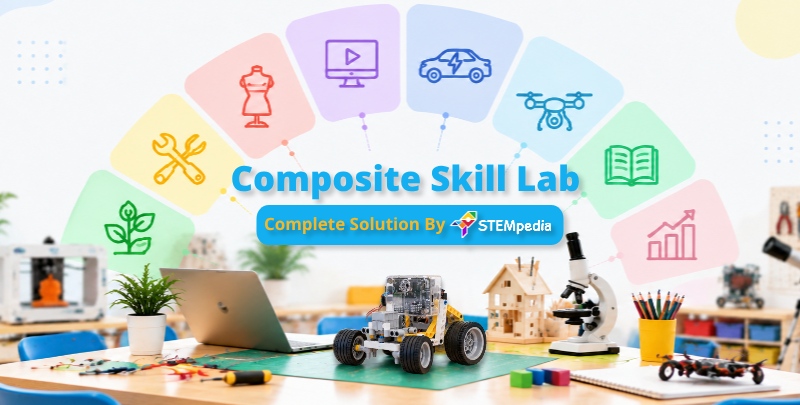
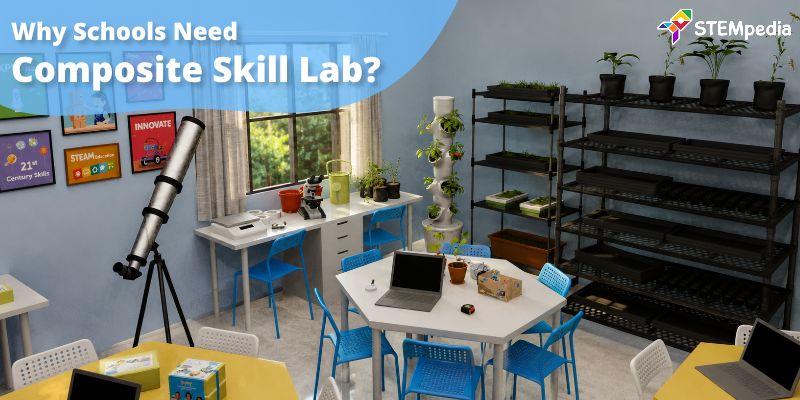
A Composite Skill Lab is a flexible, multi-sector learning environment where students can gain practical exposure to different skills, tools, technologies, and forms of work.
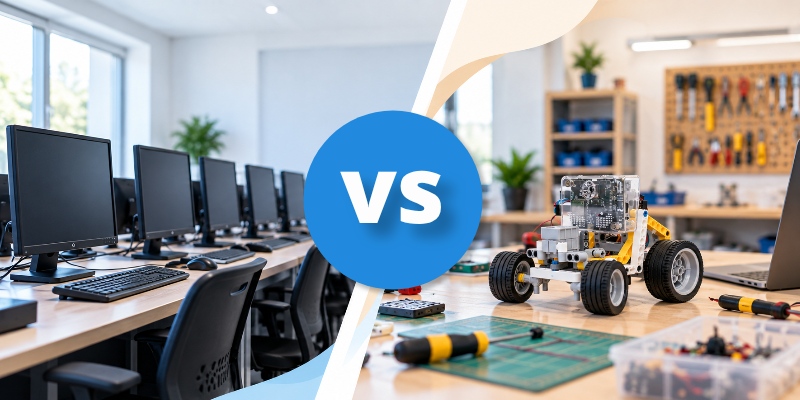
Unlike a traditional subject-specific laboratory, the idea is not to restrict the space to one activity.
The word “composite” is important because the lab brings different skill areas together in one planned environment.
A well-designed CSL can give students opportunities to:
- Work with tools and materials
- Build and test projects
- Explore technology
- Solve practical problems
- Work collaboratively
- Understand different occupations
- Develop practical competencies
- Connect classroom learning with real-world applications
STEMpedia’s KFTL Composite Skill Lab follows this practical approach, combining multiple technology and skill areas such as AI, robotics, coding, electronics, mechatronics, and machine learning within a hands-on learning environment.
Explore KFTL Composite Skill Lab by STEMpedia
Why Is the “Composite” approach important?
Imagine a school with separate rooms for electronics, robotics, agriculture, healthcare, digital skills, design, and other vocational areas.
For many schools, maintaining completely separate infrastructure for every skill area would be difficult.
The Composite Skill Lab approach provides a more flexible model.
Students can experience different forms of work within a coordinated learning environment.
The objective is therefore not:
One lab = one subject
Its
One learning environment = Multiple opportunities to explore work and skills.
This makes the CSL more adaptable to the school’s available space, resources, student interests, local context, teacher capacity, and selected skill areas.
Why were Composite Skill Labs Conceptualized in Schools?
The simplest answer is:
Composite Skill Labs were conceptualized to make practical and vocational learning a meaningful part of mainstream school education.
But this objective has several interconnected dimensions.
1. To Bridge the gap between Theory and Practice
One of the most important reasons behind the Composite Skill Lab is the gap between knowing something and being able to do something.
NCF-SE emphasises that students should have opportunities to engage with real-world tasks and projects related to their skills. CBSE similarly states that well-equipped skill labs provide the resources and environment required for practical, hands-on learning.
For example, instead of only learning that “a circuit needs a power source and electrical connections,” students can identify components, connect a circuit, test it, observe what happens, identify an error, troubleshoot it, and improve the design.
The learning becomes more than information. It becomes experience.
That is one of the fundamental ideas behind experiential learning.
2. To bring vocational education into mainstream schooling
NEP 2020 identified a longstanding problem with vocational education in India.
Vocational education had often been perceived as separate from mainstream academic education. The policy explicitly sought to overcome this divide by integrating vocational education into mainstream education and providing vocational exposure from the middle and secondary stages. It also called for every child to learn at least one vocation and be exposed to several others.
The policy also set a target that by 2025, at least 50% of learners through school and higher education should have exposure to vocational education. It envisioned collaboration with ITIs, polytechnics and local industry and specifically referred to skill labs in schools through a hub-and-spoke model.
This created a fundamental shift in thinking:
Vocational learning should not be something students encounter only after school.
It should become part of their educational experience.
The Composite Skill Lab provides one physical environment through which this philosophy can be implemented.
3. To make practical learning possible inside schools
A policy can recommend practical education, but students need space, equipment, teachers, curriculum, and time to actually experience it.
CBSE’s 2024 circular directly identified the infrastructure problem, noting that many schools lacked the facilities and equipment needed for effective hands-on training.
This is where the Composite Skill Lab becomes important.
It provides a structured environment where students can move from:

The lab therefore becomes the physical infrastructure supporting a broader pedagogical change.
For schools already having an ATL, IT Lab or makerspace, the challenge is often deciding what can be reused and what additional infrastructure is required.
STEMpedia helps schools identify how existing spaces can support CSL activities while providing a clear roadmap for developing a complete Composite Skill Lab environment.
You can also link this paragraph to your existing article on using ATL, IT Labs and makerspaces for CSL setup. This makes the product/service promotion feel contextual rather than promotional.
Learn how schools can use ATL, IT Labs and Makerspaces for CSL setup
4. To give students exposure to different forms of work
A major feature of the vocational education framework is that students should not be restricted to one narrow skill.
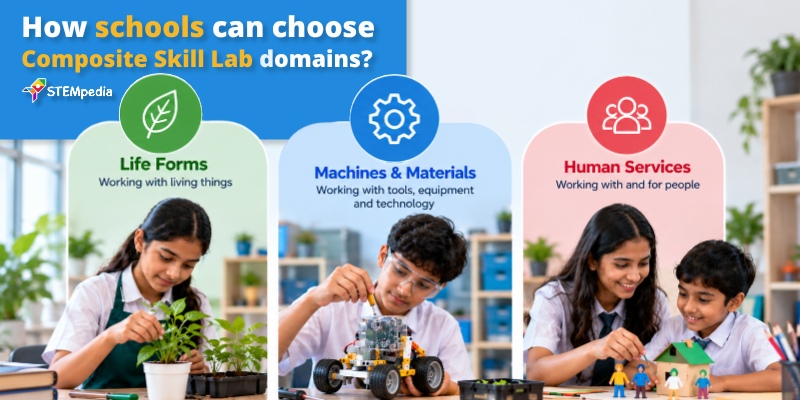
NCERT’s implementation handbook describes three broad forms of work:
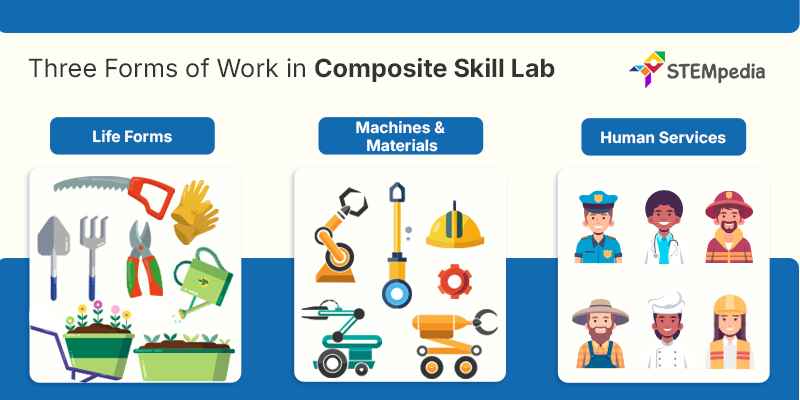
NCERT explains that these forms of work are intended to provide students with exposure to a wide range of work and develop a broad base of capacities that can transfer to other and emerging forms of work.
This is an important reason why the lab is composite.
It is not designed around one profession.
It is designed to build progressive learning through exposure, exploration, innovation, and the development of transferable skills.
5. To help students discover their interests and career pathways
Students do not always know what they want to pursue when they are introduced to a career choice on paper.
Practical exposure can change that.
A student who builds a robot may discover an interest in engineering.
Another student may enjoy designing products.
Someone else may discover an interest in futuristic farming techniques, healthcare technology, digital innovation, or entrepreneurship.
CBSE explicitly identifies career exploration beyond traditional options and the development of entrepreneurial capabilities among the expected benefits of Composite Skill Labs.
This makes the CSL more than a skill-training facility.
It can become a career exploration space.
Students get an opportunity to experience different kinds of work before making more specialised academic and career decisions.
6. To develop skills that go beyond a particular trade
A Composite Skill Lab is not only about teaching students how to use a particular machine or tool.
The deeper learning happens through the process.
When students work on projects, they learn to identify a problem, understand requirements, plan a solution, work with others, use tools, test an idea, handle failure, troubleshoot, improve the design, and communicate the final outcome.
These experiences can develop problem-solving, critical thinking, creativity, communication, collaboration, design thinking, and entrepreneurial thinking.
STEMpedia’s KFTL Composite Skill Lab model similarly emphasises critical thinking, problem-solving, design thinking, collaboration, algorithmic literacy, and entrepreneurship as outcomes that extend beyond individual technical skills.
The important point is that these capabilities are not learned effectively by memorising definitions.
They develop through learning by doing and by engaging in meaningful, practical work.
7. To build respect for the dignity of work
There is another reason behind the vocational education shift that is sometimes overlooked.
NEP 2020 recognises the social perception that vocational education is inferior to mainstream academic education and calls for this hierarchy to be addressed. The policy specifically promotes early vocational exposure, integration with mainstream education and the dignity of labour.
This means students should experience different forms of work as legitimate and valuable forms of learning.
Students working with a plant, a circuit, a robot, a piece of wood, a sewing machine, a healthcare simulation, or a digital system should be able to develop practical skills while understanding the value and purpose of different forms of work.
is not moving away from education.
8. To make the school learning environment more connected to the real world
Traditional classrooms can sometimes separate learning from the context in which knowledge is used.
A Composite Skill Lab can bring that context closer.
Consider a simple example.
Instead of only teaching students about water conservation, a project could involve identifying water usage, collecting data, understanding the problem, designing a solution, using sensors or automation, testing the system, and presenting the results.
The same project can combine:
Science + Mathematics + Technology + Problem-Solving + Communication
This is the kind of interdisciplinary learning that makes practical education meaningful.
9. To create a shared infrastructure for multiple skill areas
The Composite Skill Lab also addresses a practical challenge faced by schools: space and resource utilisation.
Instead of creating completely separate spaces for every skill area, a composite approach allows schools to plan a flexible environment supporting multiple activities.
CBSE’s 2024 circular specifies either:
- one 600 sq. ft. Composite Skill Lab for Classes VI–XII, or
- two separate 400 sq. ft. labs, one for Classes VI–X and one for Classes XI–XII.
The objective is not simply to fill that space with equipment. The space needs to support meaningful learning activities. This means schools need to consider layout, workstations, storage, safety, equipment, curriculum, teacher readiness, timetable integration, and student projects.
This is why setting up a CSL should be approached as an education implementation project, rather than simply an infrastructure purchase.
STEMpedia’s implementation approach similarly recommends beginning with the learning outcomes and practical activities the school wants the lab to enable before finalising space, equipment, staffing and curriculum decisions.
Read STEMpedia’s Composite Skill Lab implementation roadmap
10. To prepare students for a changing world of work
The world students will enter after school will not remain limited to today’s occupations.
Technology is changing how people work across agriculture, manufacturing, healthcare, finance, retail, media, design and services.
This is particularly relevant to areas such as AI, robotics, coding, electronics, IoT and digital technologies.
However, future-ready education should not mean turning every student into a programmer.
The objective should be broader:
Help students understand technology as a tool for solving problems across different areas of work.
This is also the approach STEMpedia recommends for AI within a Composite Skill Lab. AI can function as a practical layer connecting different skill areas rather than becoming an isolated computer subject.
Explore AI in Composite Skill Lab – What CBSE Means by AI Infrastructure?
How does STEMpedia help schools to turn the Composite Skill Lab concept into practice?
The next question is:
How can a school turn this vision into a working learning environment?
This is where implementation becomes important.
STEMpedia works with schools to support the development of CBSE-aligned, practical and future-ready Composite Skill Labs. Its existing CSL approach combines infrastructure planning with curriculum, technology, teacher training, and continued implementation support.
STEMpedia can support schools with:
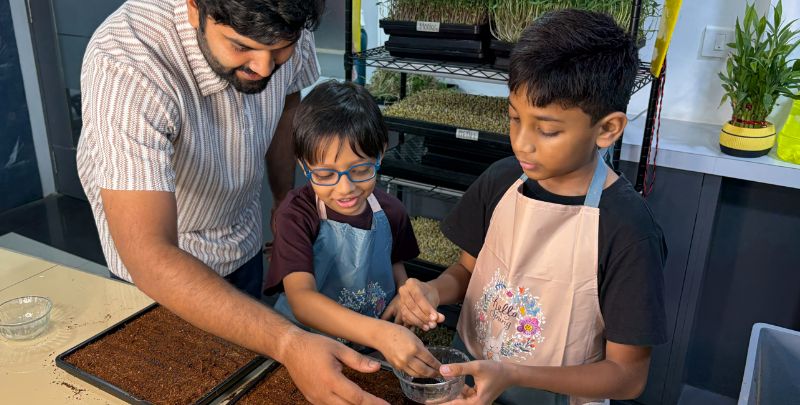
- Existing Infrastructure Audit: Schools can assess their existing ATL, IT Lab, makerspace, robotics lab, and other resources to identify what can be leveraged across Work with Life Forms, Work with Machines and Materials, and Work in Human Services.
- Lab Planning and Layout: The lab can be planned around available space, student strength, selected skill sectors, workstations, storage, and safety requirements to support all three forms of work.
- AI, Coding, Robotics: Technology can be integrated through PictoBlox, Quarky, and Quarky Intellio, supporting Work with Machines and Materials through coding, AI, robotics, IoT, and physical computing, while enabling projects connected to Life Forms and Human Services.
- Curriculum and Projects: STEMpedia’s approach combines infrastructure with grade-wise learning resources, projects, and assessments covering Life Forms, Machines and Materials, and Human Services.
- Teacher Training: Teachers can be prepared to facilitate hands-on and project-based learning across the three forms of work, rather than focusing only on equipment operation.
- Long-Term Implementation: Regular sessions and structured projects across Life Forms, Machines and Materials, and Human Services can help schools make the CSL part of their regular learning ecosystem.
Explore Teacher Training for Composite Skill Labs
For schools who planning their Composite Skill Lab setup, technology integration, or teacher readiness, STEMpedia can support the journey from infrastructure planning to regular hands-on learning. This creates a multi-sector practical learning environment where technology is connected with different forms of work and real-world applications.
- PictoBlox – Block Coding, Python, AI, Machine Learning, IoT and physical computing
- Quarky – Robotics, sensors, movement and hands-on AI projects
- Quarky Intellio – Computer vision, audio interaction, AR and intelligent robotics
Conclusion
The Composite Skill Lab was conceptualized because school education needed a stronger connection between knowledge, skills, practical work, and the world beyond the classroom.
NEP 2020 established the broader policy direction of integrating vocational education into mainstream education, providing early exposure to different vocations and promoting the dignity of labour.
NCF-SE 2023 and related NCERT vocational education resources provide a framework for exposing students to different forms of work through practical experiences.
CBSE’s Composite Skill Lab initiative provides the infrastructure mechanism through which schools can support this practical learning. The Board explicitly links CSLs with hands-on learning, industry-aligned skills, career exploration, and entrepreneurship.
So, the real purpose of a Composite Skill Lab is not simply to create another laboratory.
It is to create a place where students can learn by doing, explore different forms of work, build practical competencies, and begin understanding how their learning connects with the real world.
And when infrastructure, curriculum, technology, and teacher readiness come together, the CSL can become much more than a school facility.
It can become a space where students move from learning concepts to applying them.