Once a school decides to establish a Composite Skill Lab (CSL), choosing what students will actually learn inside it becomes one of the most important decisions.
Schools may naturally ask:
Which three CSL domains should we choose?
There is an important clarification.
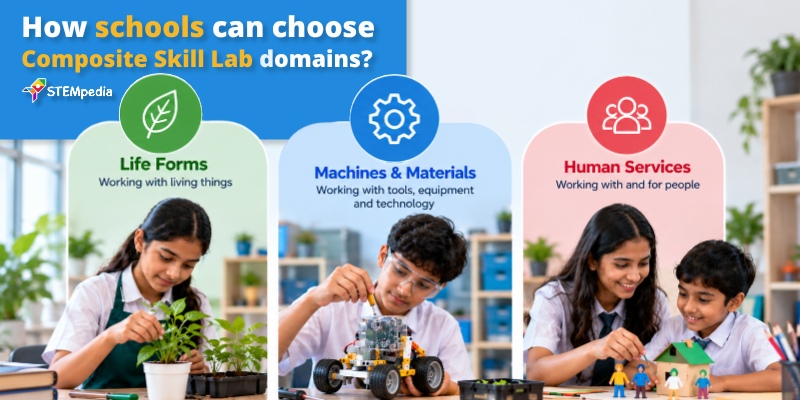
CBSE and NCF-SE use the term Forms of Work, not simply “domains”. The three Forms of Work are:
Work with Life Forms → Work with Machines & Materials → Work in Human Services
Schools are expected to expose students to all three. Schools select the skill subjects, sectors, and activities within those forms.
CBSE’s current CSL guidelines recommend that the lab should be capable of supporting six skill subjects over two years, spanning all three Forms of Work. The guidelines specifically ask schools to consider local context, resources, teacher qualifications, and access to local businesses or industries when making that choice.
So the question is not simply:
“Which three subjects should we buy equipment for?”
A better question is:
“Which combination of skills will be relevant, teachable and sustainable for our students?”
Answer at a Glance
A school should choose its CSL skill sectors by considering five things first:
Students → Local Context → Existing Resources → Teacher Readiness → Industry Exposure
Then check that the final combination covers all three Forms of Work.
The strongest CSL is not the one with the largest equipment list. It is the one where students can regularly make, test, practise, solve problems, and connect their learning with real work.
First, Understand the Three Forms of Work
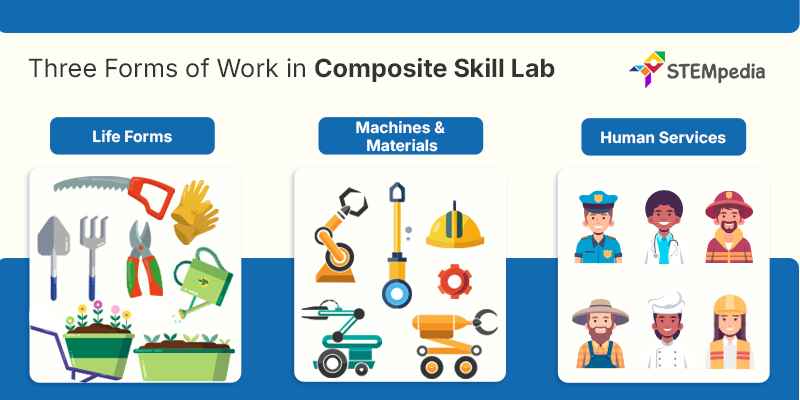
NCERT defines the three Forms of Work as broad categories of productive activity. At the Middle Stage, the objective is to give students a wide and experiential introduction to work rather than narrow occupational specialisation.
1. Work with Life Forms
This covers practical work involving plants, animals, and living systems.
Possible sectors include:
- Agriculture & Gardening
- Floriculture
- Nursery-related activities
- Food Production
- Other locally relevant life-form activities
Students could grow plants, understand soil, explore irrigation, monitor environmental conditions or combine agriculture with sensors and data.
This can be particularly meaningful for schools with gardens, green spaces or strong connections with agricultural communities.
2. Work with Machines & Materials
This covers practical work involving tools, machines, materials and technology.
Relevant sectors include:
- Electronics / Mechatronics
- Coding and IT
- Robotics
- Carpentry / Woodwork
- Apparel
- Automotive
- AVGC & Media Content Creation
Students may build circuits, programme robots, work with sensors, make prototypes, use tools or troubleshoot systems.
NCERT specifically includes examples such as machining, tailoring, carpentry, pottery and robotics within this Form of Work.
A school with an ATL, robotics lab, or IT Lab may already have a strong foundation here.
However:
Robotics + Coding + AI + Electronics are different activities, but they are still largely concentrated within one Form of Work.
A complete CSL should provide wider exposure.
3. Work in Human Services
This covers work where students learn to understand people’s needs and provide services.
Relevant sectors include:
- Healthcare
- Retail
- BFSI
- Tourism & Hospitality
- Beauty & Wellness
Students may explore healthcare procedures, customer interaction, financial literacy, retail simulations, hospitality, or service communication.
NCERT highlights communication, interpersonal skills, and understanding people’s needs as important capacities within this form.
How Should Schools Choose Their Skill Sectors?
1. Start with the Local Context
The first question should be:
What kinds of work and industries exist around our students?
CBSE specifically recommends selecting skill subjects that are relevant to the local context and aspirations of the school.
For example:
Agricultural region
Agriculture + Food Production + Retail
Manufacturing region
Electronics/Mechatronics + Automotive + Healthcare or Retail
Textile cluster
Apparel + Digital Media + Retail
Tourism destination
Tourism + Hospitality + Digital Media
Urban technology ecosystem
Electronics/Mechatronics + IT/ITeS + BFSI or Healthcare
The principle is simple:
Choose skills students can connect with the world around them.
This makes career exploration and workplace exposure far more meaningful.
2. Consider Student Interests and Aspirations
A CSL should reflect what students are curious about, not only what adults decide to purchase.
Schools can understand student interest through:
- Short surveys
- Career-interest activities
- Trial workshops
- Teacher observations
- Parent discussions
- Career counselling
Students interested in engineering may naturally respond to Electronics/Mechatronics.
Students interested in entrepreneurship could connect:
Apparel + Digital Media + Retail + BFSI
Student interest should not determine the entire decision, but it should be an important part of it.
3. Audit Existing Infrastructure Before Buying Anything
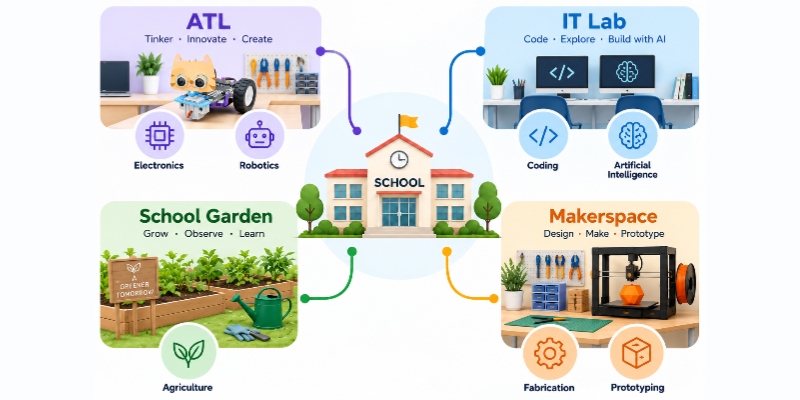
Before choosing sectors, schools should ask:
What do we already have → What can we reuse → What is still missing?
| Existing Resource | Possible CSL Support |
| IT Lab | Coding, AI, finance, animation, digital media |
| ATL / Agile ATL | Electronics, robotics, mechatronics, IoT |
| School Garden | Agriculture and gardening |
| Home Science Resources | Food Production |
| Makerspace | Fabrication, carpentry, sewing, prototyping |
| Existing Skill Lab | Relevant sector-specific activities |
CBSE asks schools to map available tools, equipment, raw materials and teacher qualifications when identifying skill subjects.
Existing facilities can therefore reduce unnecessary procurement, but they should be treated as supporting infrastructure rather than automatically being relabelled as the complete CSL.
For schools already operating these spaces, see How Schools Can Use ATL, IT Labs and Makerspaces for CBSE Composite Skill Lab Setup.
4. Check Teacher Readiness
The best equipment will remain underused if teachers are not confident enough to facilitate practical activities.
Before selecting a sector, ask:
- Do we already have suitable teachers?
- Can current teachers be trained?
- Who will supervise practical work?
- Can teachers troubleshoot basic issues?
- Is continued training available?
NCERT notes that teachers from different subjects can support vocational projects according to their suitability, while local experts can be brought in for specialised skills.
A useful planning sequence is:
Skill Sector → Teacher Readiness → Activities → Equipment
not:
Equipment → Find Someone to Teach It
For deeper planning, see Teacher Training for Composite Skill Labs – How Schools Can Build CSL Readiness.
5. Map Local Industry and Community Expertise
CBSE recommends considering access to businesses and industries that can provide:
- Field visits
- Guest experts
- Practical demonstrations
- Workplace exposure
- Career information
- Further study pathways
This can directly influence sector selection.
For example:
Hospital nearby → Healthcare
Textile industry → Apparel
Manufacturing cluster → Electronics / Mechatronics / Automotive
Hotel ecosystem → Tourism & Hospitality
Agricultural community → Agriculture & Food Production
A sector becomes more useful when students can experience how those skills are applied beyond school.
6. Check Curriculum and Learning Progression
A school should not select a sector simply because it offers one impressive activity.
Ask:
Can students progress from basic exposure to meaningful projects over several years?
For Electronics, that could look like:
Identify Components → Build Circuit → Connect Sensors → Code a System → Solve a Real Problem
The same progression should exist for agriculture, healthcare, apparel, retail, or any other chosen area.
CBSE currently provides Kaushal Bodh for Classes VI–VIII as mandatory Skill Education for the 2026–27 session, alongside skill curriculum for higher classes.
The sector should therefore support progressive learning, not isolated demonstrations.
7. Consider Cost Beyond the Initial Purchase
Sector selection directly affects:
- Equipment
- Consumables
- Replacement parts
- Storage
- Safety equipment
- Software
- Maintenance
- Teacher training
- Annual replenishment
Some sectors require substantial physical infrastructure, while others can use more of the school’s existing resources.
The right question is not:
“Which sector costs the least?”
It is:
“Which sector can we continue using meaningfully year after year?”
CBSE itself states that CSL expenditure varies depending on the skill subjects selected, laboratory size, furniture, and required quantities.
For detailed budgeting, refer to How Much Does It Cost to Set Up a CBSE Composite Skill Lab?.
8. Check the Final Balance Across All Three Forms of Work
This is where schools should review the final combination.
For example:
Robotics + Electronics + Coding
may appear to provide three distinct subjects.
But all three are strongly concentrated within:
Work with Machines & Materials
A more balanced starting combination could be:
Agriculture & Gardening
→ Work with Life Forms
Electronics / Mechatronics
→ Work with Machines & Materials
Healthcare
→ Work in Human Services
The school can then expand the offering.
Current CBSE guidance recommends that the lab should support six skill subjects across two years, covering all three Forms of Work.
9. Look for Cross-Sector Project Opportunities
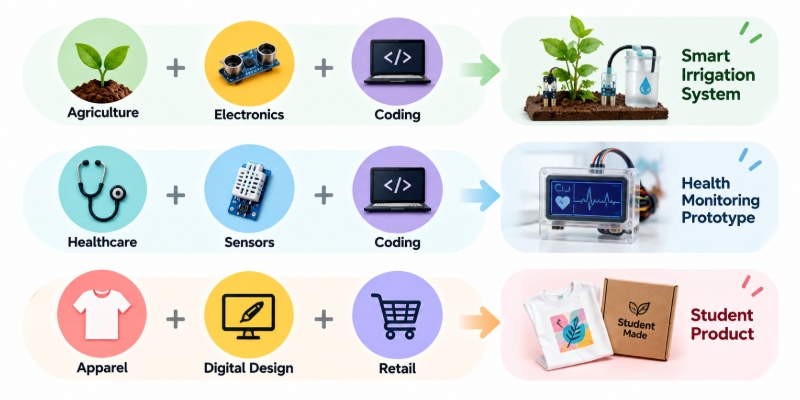
The word Composite becomes meaningful when students begin connecting skills.
For example:
Agriculture + Electronics + Coding
→ Smart irrigation
Healthcare + Sensors + Coding
→ Health-monitoring prototype
Apparel + Digital Design + Retail
→ Design, make, and market a product
Food Production + BFSI + Retail
→ Student enterprise simulation
CBSE specifically highlights cross-sector application—for example, applying mechatronics and AI skills to agricultural challenges.
This is more valuable than treating every skill subject as a separate island.
Example Skill-Sector Combinations
These are examples rather than prescribed CBSE packages.
1. Technology-Oriented Urban School
Life Forms: Agriculture & Gardening
Machines & Materials: Electronics/Mechatronics + IT/ITeS
Human Services: Healthcare + BFSI
This allows technology to remain strong without turning the CSL into only another robotics or computer lab.
2. Agriculture-Focused Region
Life Forms: Agriculture & Gardening + Food Production
Machines & Materials: Electronics/Mechatronics
Human Services: Retail + Healthcare
Students could connect agriculture with automation, production, and local enterprise.
3. School with Strong Existing Digital Infrastructure
Life Forms: Agriculture & Gardening
Machines & Materials: IT/ITeS + AVGC & Media Content Creation
Human Services: BFSI + Tourism & Hospitality
This model can leverage existing computers while the school gradually develops its wider practical infrastructure.
NCERT’s implementation handbook similarly encourages schools to choose vocations based on their own context and available community resources rather than following one fixed combination.
From Sector Selection to Actual CSL Setup
Once the skill-sector mix is clear, procurement becomes much easier.
Schools can then determine:
Selected Skills → Activities → Curriculum → Space → Tools → Safety → Teacher Training
rather than buying equipment first.
For the next stage of planning:
- Use Composite Skill Lab Tools and Equipment for CBSE Schools when translating selected sectors into equipment requirements.
- Use How to Set Up a Composite Skill Lab in Phases – From Readiness to Launch when moving from selection to implementation.
For schools exploring how AI, coding, electronics, and robotics can be implemented practically within Work with Machines & Materials, the KFTL Composite Skill Lab by STEMpedia provides a useful implementation example.
Conclusion
Choosing the right skill sectors for a Composite Skill Lab should begin with students and learning—not equipment.
The three Forms of Work provide the framework. Within that framework, each school should create its own combination based on:
Students + Local Context + Teachers + Infrastructure + Industry + Curriculum + Sustainability
The right CSL is therefore not necessarily the one offering the most technologies or the most expensive equipment.
It is the one where students can consistently:
Explore → Work → Make → Test → Solve → Connect → Apply
When skill-sector selection is approached this way, the Composite Skill Lab becomes more than an infrastructure requirement.
It becomes a practical learning environment that connects school education with real skills, real work and future opportunities.
Frequently Asked Questions
1. What are the three CSL domains?
Answer: The official framework refers to them as the three Forms of Work:
- Work with Life Forms
- Work with Machines & Materials
- Work in Human Services
2. Does a school select only three skill subjects?
Answer: No. The current CBSE guideline recommends that a CSL should be capable of providing six skill subjects over two years, collectively covering all three Forms of Work.
3. Can Robotics, Coding and AI be the three CSL domains?
Answer: They can all be valuable CSL activities, but they are primarily concentrated within Work with Machines & Materials. Schools should also provide exposure to Life Forms and Human Services.
4. How should a school decide which sectors to select?
Answer: Prioritise local relevance, student aspirations, existing resources, teacher capability, curriculum availability, industry access and long-term sustainability. These closely reflect CBSE’s current selection principles.
5. Can existing ATL or IT Lab resources influence the choice?
Answer: Yes. They can support relevant CSL activities and help reduce duplicate procurement. However, existing specialised labs should be considered within the school’s wider CSL plan rather than assumed to represent the complete CSL. For detailed guidance, see How Schools Can Use ATL, IT Labs and Makerspaces for CSL Setup.
6. Is Kaushal Bodh mandatory for Classes VI–VIII?
Answer: Yes. CBSE’s 2026–27 Skill Education resources state that Kaushal Bodh is mandatory for Classes VI–VIII.